
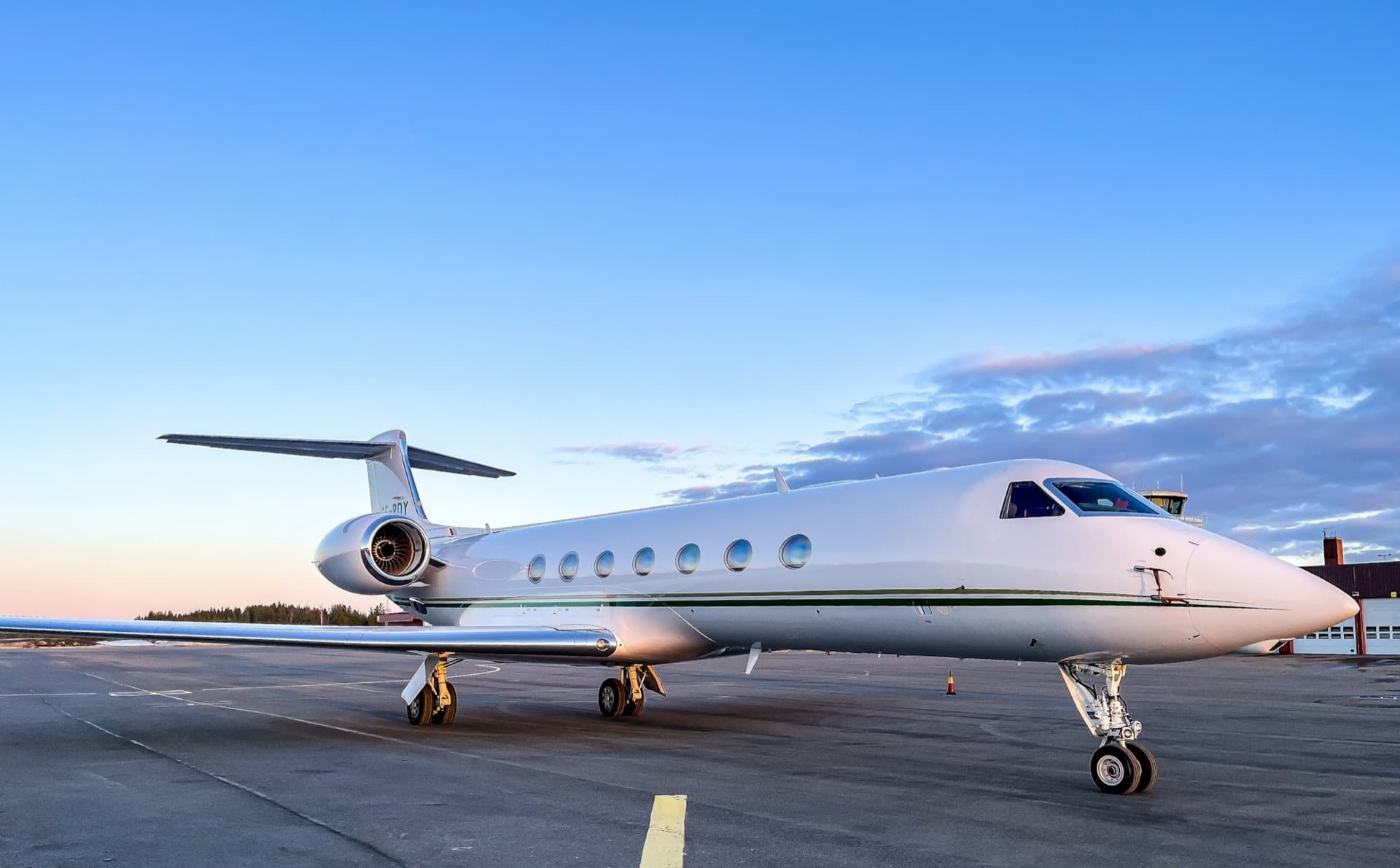
Flying Private, Explained
30 short lessons on how private jet charter really works, one a day, each with its sources.
See all 30 lessonsI wrote these 30 short lessons for anyone weighing a private flight: what flying private really is, what shapes the cost, and why not every aircraft can go everywhere. Each one is short, and each one links to the sources it rests on so you can check my work.
The Scott Wallace Agency is an air charter broker, not a direct air carrier. Flights are operated by FAA-certificated Part 135 air carriers, which hold operational control.
Day 1of 30
What you are actually buying
A charter buys the whole aircraft and its crew on your schedule, and it opens up thousands of public airports beyond the 390 where 99 percent of airline passengers board.
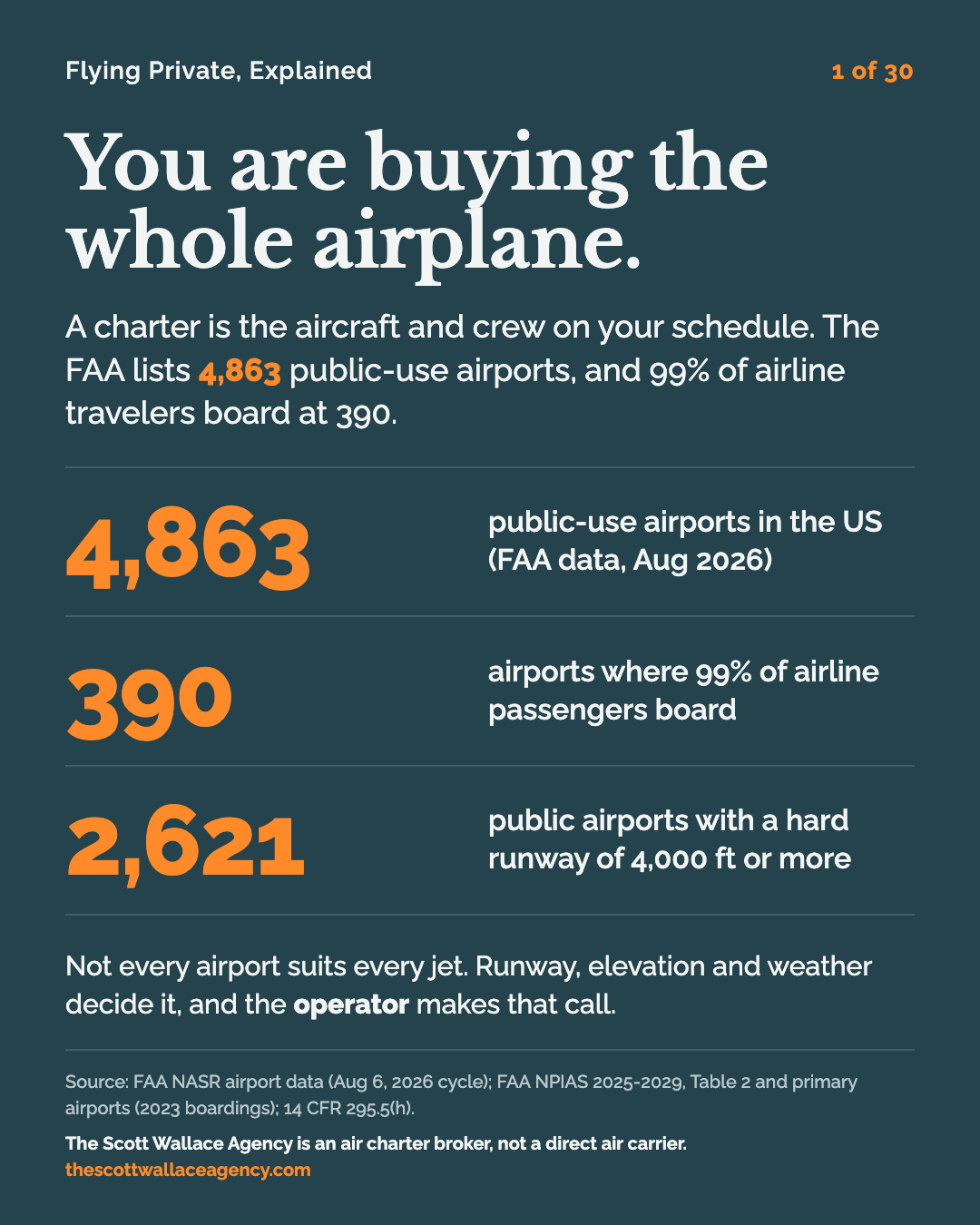
The FAA's airport data lists 4,863 public-use airports in the United States. The FAA's national airport plan counts 390 primary airports, the ones with scheduled airline service and at least 10,000 boardings a year, and those 390 handle 99 percent of airline passenger boardings.
That gap is a large part of what a charter buys. When you charter, you contract for the whole aircraft and its crew. Federal rules call this a single entity charter: a charter for the entire capacity of the aircraft, paid for by the charterer and not by individual passengers buying seats. You choose the departure time, and you choose the airport, within what the aircraft, the runway and the weather allow.
The airport choice is where most of the time comes back. In the same FAA data, 2,621 public airports have a hard-surface runway of at least 4,000 feet. Many of them sit closer to a job site, a plant or a second home than the nearest airline hub.
That number is a starting point, not a list of places any jet can go. Whether a specific aircraft can use a specific airport on a specific day depends on:
- runway length and surface, and the 60 percent landing rule covered on Day 17
- airport elevation and temperature
- the weather forecast at arrival time
The operator and its crew run those numbers and make the final call on every flight. My job as a broker is to know which airports and aircraft are worth asking about before you get attached to a plan.
Over the next 30 days this series walks through how charter works, one piece a day, from who is responsible for your flight to what shows up on the final invoice.
Sources
Day 2of 30
What it does not give you
A charter still runs under weather minimums, crew duty and rest limits, runway weight limits and normal passport rules, and the crew duty limit is the one that most often reshapes a same-day trip.
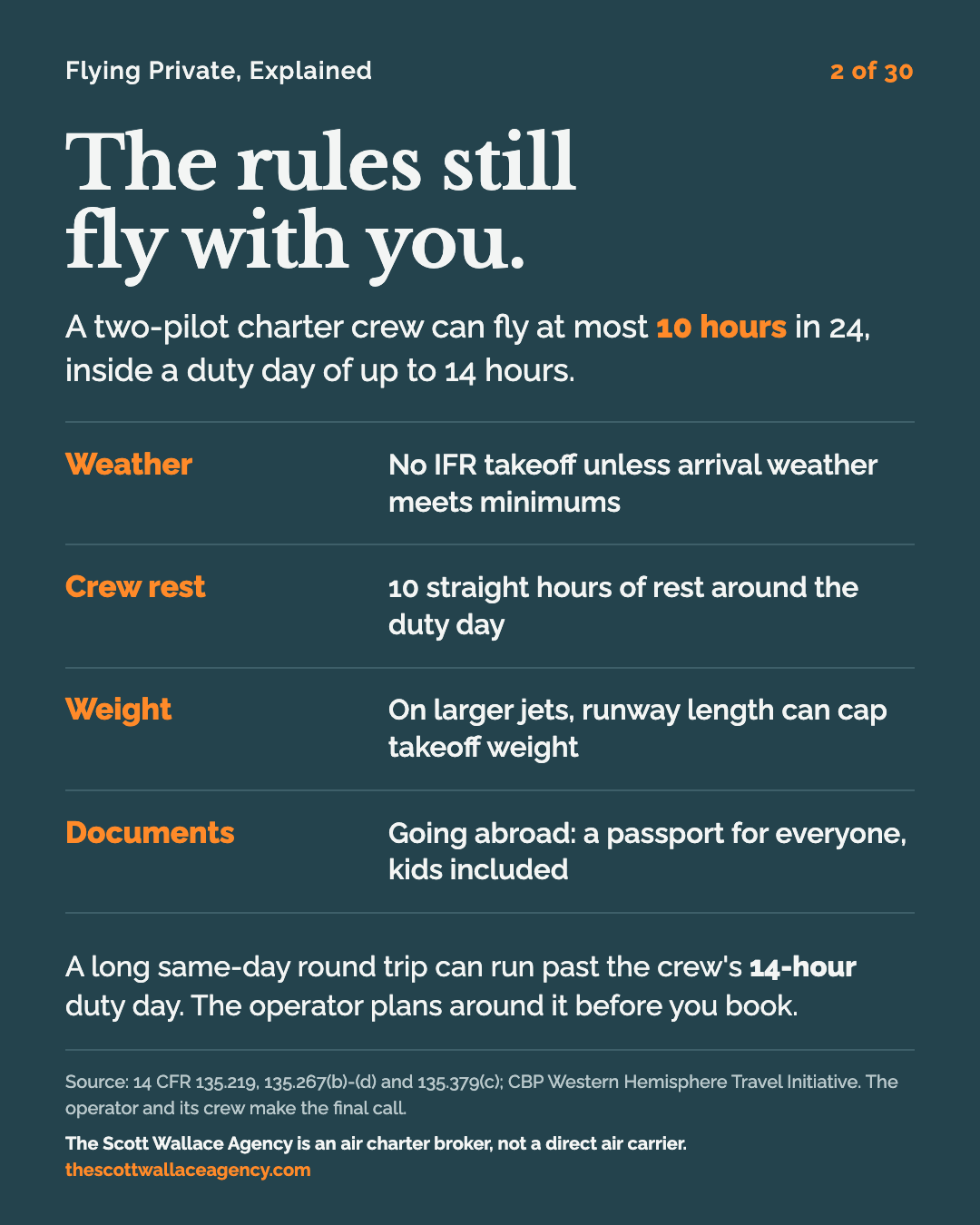
Chartering changes who you fly with and when. It does not change the rules the flight runs under. Four of them shape real trips.
Crew duty and rest. For an unscheduled crew of two pilots, the charter rules allow up to 10 hours of flight time in 24 hours. Flight time can stay within those limits inside a regularly assigned duty period of no more than 14 hours, with at least 10 consecutive hours of rest before and after it (14 CFR 135.267). The airplane can sit on the ramp all afternoon. The crew's day keeps counting. If a same-day round trip runs longer than the crew can legally work, the operator has to solve it, usually with a second crew or an overnight, and that shows up in the quote.
Weather. A charter flight cannot take off on an instrument flight plan unless the latest weather reports or forecasts show conditions at or above the authorized landing minimums at the next airport, at the estimated time of arrival (14 CFR 135.219). Private does not mean the flight goes in weather the airlines would wait out.
Weight. For larger turbine transport category jets, the takeoff weight is limited so that the takeoff and accelerate-stop distances fit the runway (14 CFR 135.379). On a short or high-elevation runway, that can mean less fuel and a fuel stop on the way.
Documents. Leaving the country, every U.S. citizen needs a passport or another document CBP accepts for air travel, and children need their own. You clear customs on the way back like any other traveler.
The operator and its crew make the final call on every flight. My job is to plan the schedule around these limits up front, so a trip that looks simple on a calendar still works on the day.
Sources
- 14 CFR 135.267, flight time limitations and rest requirements, unscheduled one- and two-pilot crews (opens in a new tab)
- 14 CFR 135.219, IFR destination airport weather minimums (opens in a new tab)
- 14 CFR 135.379, large transport category airplanes, turbine engine powered, takeoff limitations (opens in a new tab)
- U.S. Customs and Border Protection, Western Hemisphere Travel Initiative (opens in a new tab)
Day 3of 30
Operator, broker, management company
On a charter, only the certificated operator holds operational control; a management company is the operator only on trips flown under its own certificate, and a broker never is, and the broker must name the operator before you sign.
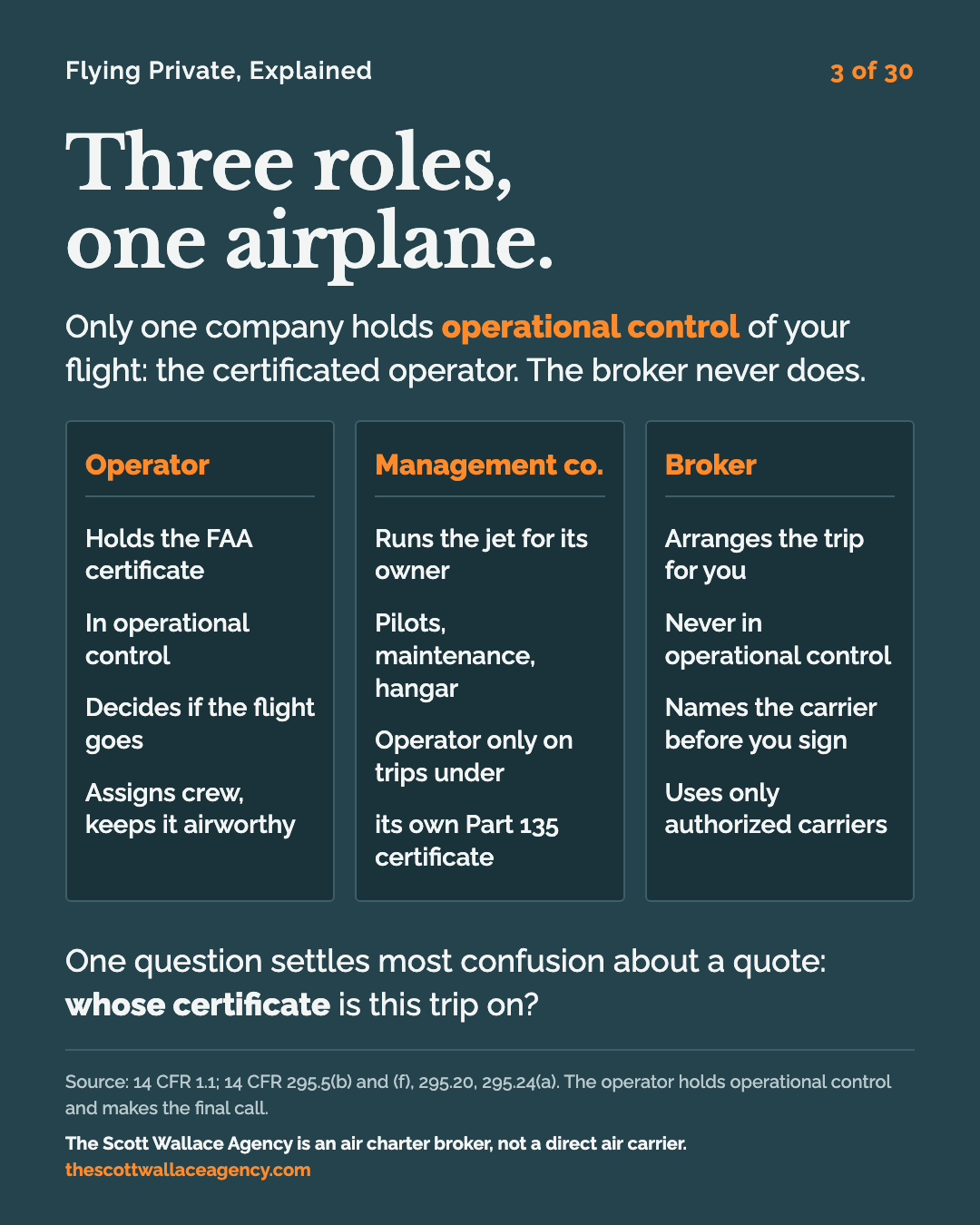
Three kinds of companies show up around a charter flight, and they do different jobs. The difference matters most on one question: who is responsible for your flight.
Federal rules define operational control as the exercise of authority over initiating, conducting or terminating a flight (14 CFR 1.1). On a charter, that authority belongs to the certificated operator, the company that holds the FAA certificate. It decides whether the flight goes, assigns the crew and keeps the aircraft airworthy.
A management company runs an airplane for its owner: pilots, maintenance, hangar and paperwork. Some management companies also hold a Part 135 certificate and fly the airplane for charter when the owner is not using it. On those trips the management company is the operator. On the owner's own flights it is not. Same airplane, same pilots, a different responsible party depending on the trip.
An air charter broker holds out, sells or arranges charter using a direct air carrier, defined as the carrier that has control over the operational functions of the flight (14 CFR 295.5). A broker may only use carriers with the required DOT and FAA authority (295.20). Before you sign a contract, the broker must disclose:
- the corporate name of the carrier in operational control of the aircraft
- the capacity the broker is acting in, for example as your agent or the carrier's
- whether the broker holds liability insurance covering you, and its limits
Other disclosures, such as the total cost including taxes and fees, are available on request (295.24).
Scott Wallace Agency is an air charter broker and a Stratos Jets franchise. We do not own, manage or operate aircraft. The operator holds operational control and makes the final call on every flight. If you are holding a quote and are not sure who is behind it, ask whose certificate this trip is on, or send it to me and I will walk through it with you.
Sources
Day 4of 30
Part 135 in plain English
Part 135 is the certificate an operator needs to fly you for hire, and a passenger can check it directly: the operator's legal name, its certificate, whether this aircraft is authorized for charter, and whether the quote carries federal excise tax.
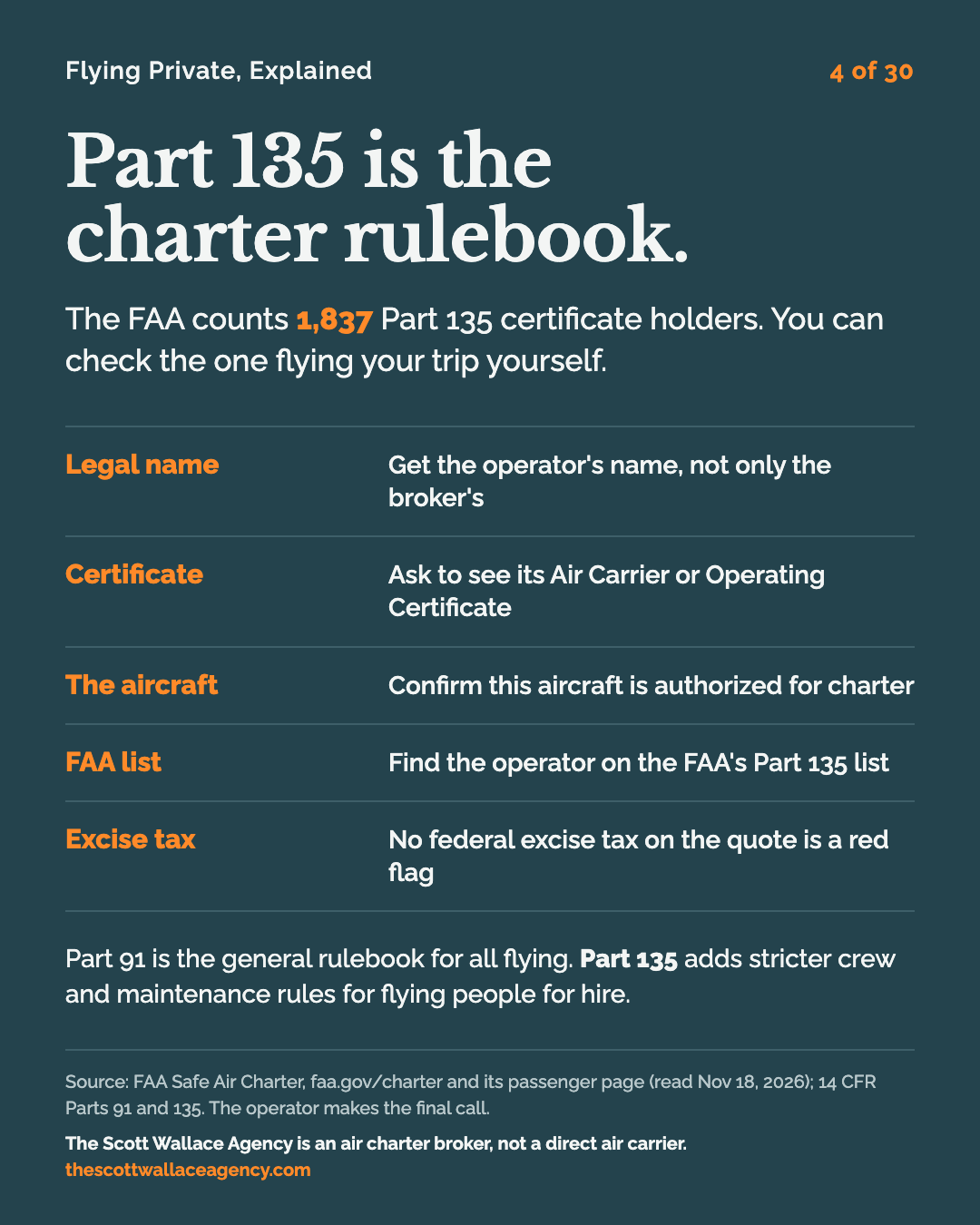
Part 91 is the general set of operating rules for all flying, including an owner flying their own airplane. Part 135 is the certificate a company needs to fly passengers for hire on demand, and the FAA describes it as requiring a higher level of pilot training and certification, maintenance procedures and safety rules than a pilot taking family or friends for a ride.
As of November 18, 2026, the FAA's Safe Air Charter page lists 1,837 Part 135 certificate holders and 11,582 authorized aircraft. A company that flies you for hire without that certificate is running an illegal charter, and the FAA asks passengers to help spot them.
You can check an operator yourself, and the FAA encourages it:
- Get the operator's legal name. On a brokered trip, the broker must give it to you before you sign (14 CFR 295.24).
- Ask to see the Air Carrier or Operating Certificate to confirm the aircraft is authorized for charter use. The FAA's advice is that if the operator refuses, look for one that will show you.
- Find the operator on the FAA's list of certificated air charter operators, linked from faa.gov/charter.
- Check the quote for federal excise tax. The FAA lists a lack of federal excise tax as a sign a company may not be a legitimate operator, because legitimate operators have to charge it.
The FAA's other red flags include anyone trying to hand you operational control in a document while also providing the aircraft and crew, a missing safety briefing, and evasive answers.
I run these checks on every trip I arrange, along with third-party safety audits and insurance. The operator holds operational control and makes the final call on the flight. If you already have a quote and want a second look, send it to me.
Sources
Day 5of 30
What an FBO is and what your day looks like
Private flights leave from an FBO, a private terminal on the airfield, and for most trips you plan to arrive about 15 minutes before departure instead of hours.
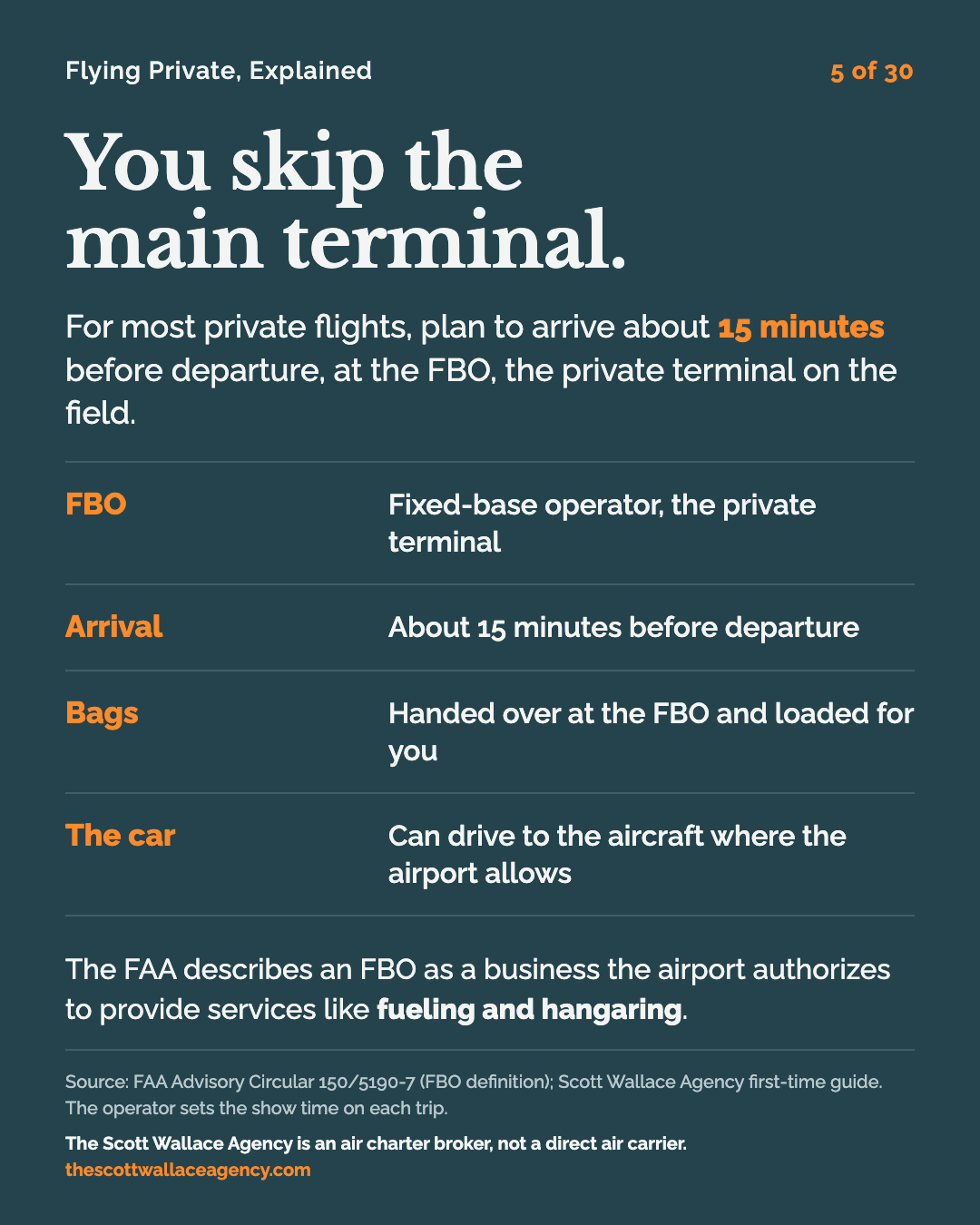
For most private flights, plan to arrive about 15 minutes before your scheduled departure. The reason is simple: you do not use the airline terminal.
You go to the FBO, short for fixed-base operator. The FAA describes an FBO as a commercial business the airport sponsor authorizes to operate on the airport and provide aeronautical services such as fueling, hangaring, tie-down and parking. For a passenger, it is the private terminal on the airfield. Many airports have one, and busy ones often have several, so the exact FBO and its address are on your trip confirmation.
A typical departure looks like this:
- You arrive at the FBO, and someone takes your bags to be loaded.
- The crew finishes preflight while you wait in the lounge.
- You walk across the ramp to the aircraft. Where the airport and the FBO allow it, a car can drive you right to the airplane.
- On arrival, you land on the private side of the field, your bags come off onto the ramp, and your car meets you at the FBO.
Two things change that picture. The operator sets the show time on every trip, and an international departure can need more time for documents. And the short morning depends on the passenger names, weights and special items being sorted out ahead of time, which is part of what I handle before the day.
If you want ground transportation or catering arranged with the trip, those are coordinated through the operator and local vendors. The operator and its crew make the final call on the flight itself.
Day 6of 30
Charter, jet card, fractional or ownership
How many hours you fly a year picks the model: under about 25, paying per trip usually wins; past 25 a jet card or a mix starts to compete; the smallest fractional share is one sixteenth of an aircraft, roughly 50 hours a year.
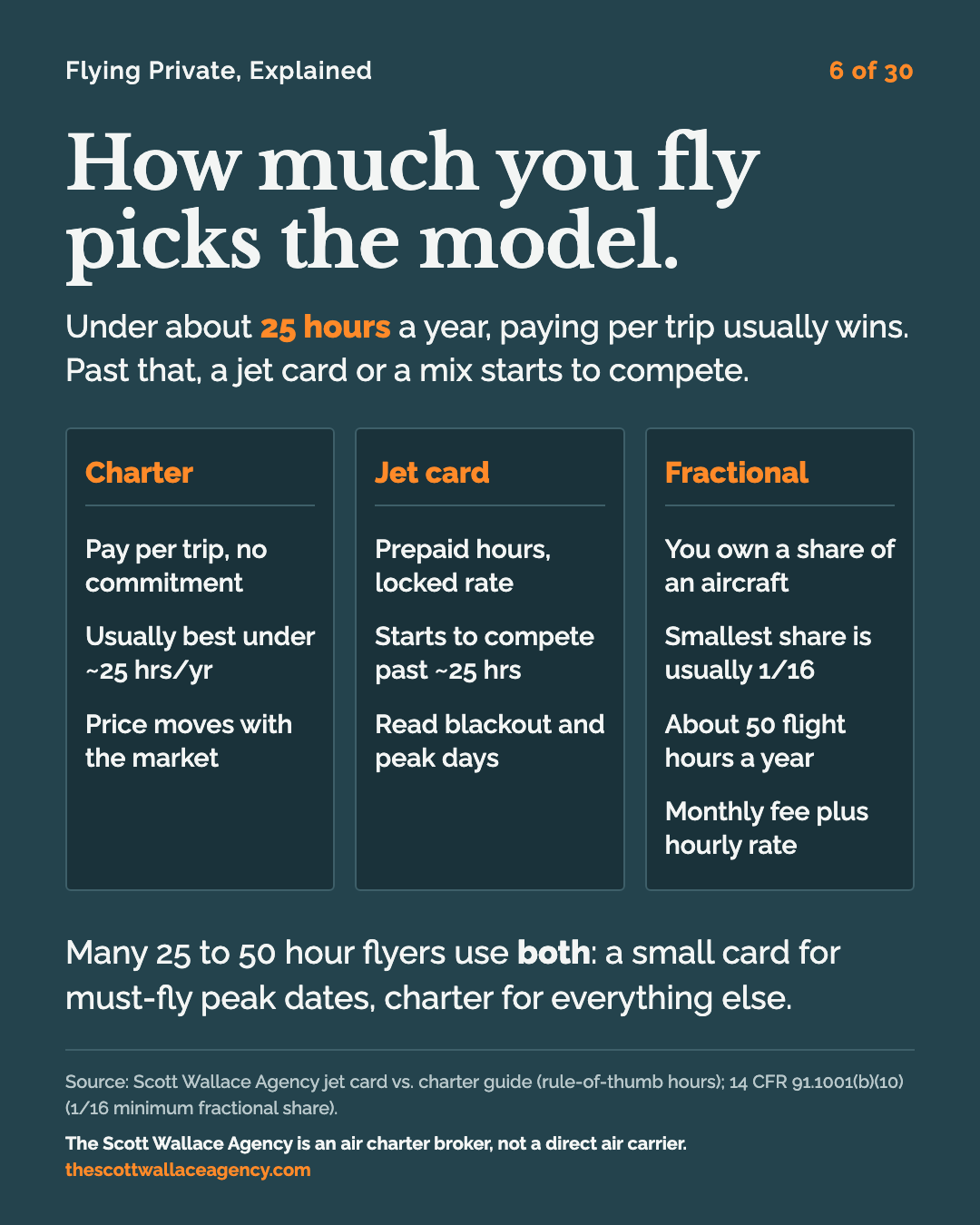
Most private flying is bought one of four ways, and the number of hours you fly in a year does most of the sorting.
- On-demand charter. You pay per trip with no upfront commitment. Pricing floats with the market, so peak windows cost more. Under about 25 flight hours a year, this is almost always the better fit.
- Jet card. You prepay a block of hours or a deposit and draw it down at a locked hourly rate on a set aircraft category. Around 25 hours a year is the industry's rule-of-thumb line where a card can start to earn its premium. Read the blackout dates, peak-day surcharges and expiration terms before funding one.
- Fractional ownership. You buy a share of a specific aircraft and pay a monthly management fee plus an hourly rate. FAA rules set the minimum fractional share at one sixteenth of a fixed-wing aircraft, which usually works out to roughly 50 flight hours a year. It ties up capital and comes with a multi-year commitment and resale terms.
- Whole ownership. A larger decision with its own costs and its own math. I would rather work through your actual flying than quote a threshold.
Many people in the 25 to 50 hour range use a hybrid: a small card sized to must-fly peak trips, and on-demand charter for flexible and one-way trips. It only works if someone compares the card rate against live quotes on each trip.
Scott Wallace Agency does not sell jet cards. We arrange on-demand charter with vetted Part 135 operators, and when a card or a hybrid is the better answer for how you fly, we will say so and help you compare. Whatever you buy, the operator flying the trip makes the final call on the flight itself.
Day 7of 30
Empty legs: what they are and what they are not
An empty leg is a repositioning flight that exists because of someone else's trip, so its route and time are fixed by that trip and it can change or cancel when that trip does.
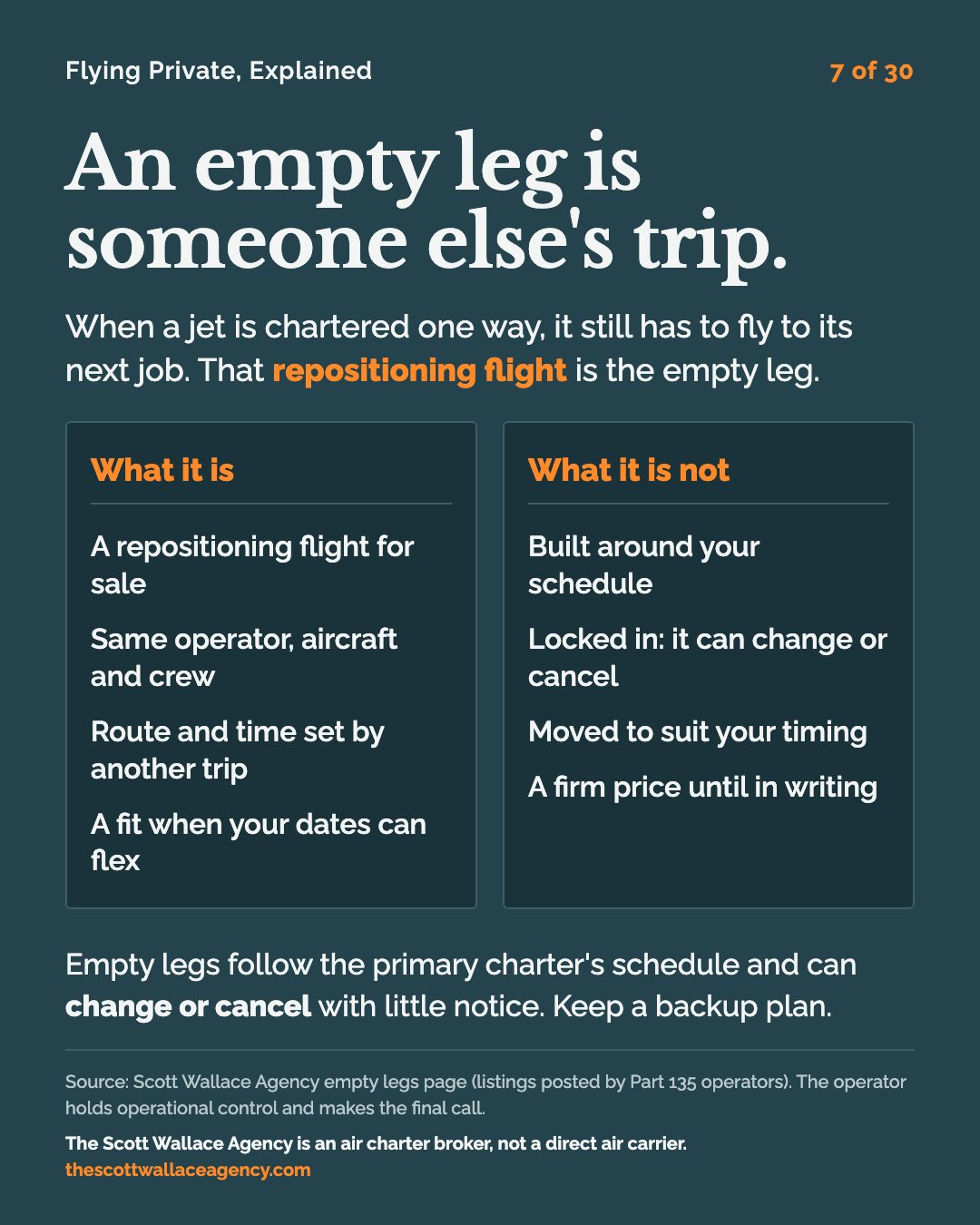
An empty leg is a repositioning flight. When an aircraft is chartered one way, the operator still has to fly it to its next trip or back to base. Operators list those flights for sale rather than fly them with nobody aboard.
What an empty leg is:
- A real charter flight, flown by the same operator, aircraft and crew under the same Part 135 certificate.
- A flight whose route and time are set by another client's trip.
- A good fit when your dates and airports can flex.
What an empty leg is not:
- Built around your schedule. If the primary charter moves, the leg moves with it.
- Locked in. Empty legs follow the primary charter's schedule and can change or cancel with little notice.
- A firm price. Dates, routes and prices are estimates until confirmed in writing, and every flight is subject to operator availability and safety approval.
That last pair is the part people learn the hard way. If you have a meeting you cannot miss, book the trip you need and treat any empty leg as a possible bonus, with a backup plan behind it. If your schedule is open, alerts let you watch the routes you fly and act when one fits.
Scott Wallace Agency is an air charter broker under 14 CFR Part 295, not an air carrier. Empty legs on our site are posted and operated by FAA Part 135 air carriers, which hold operational control. I check the operator and the aircraft the same way I would for a full charter, and the operator makes the final call on every flight.
Day 8of 30
How a charter price is built
A charter quote is the hourly rate times the billed hours, plus empty positioning time, a daily minimum of usually at least an hour, and taxes and fees on top.
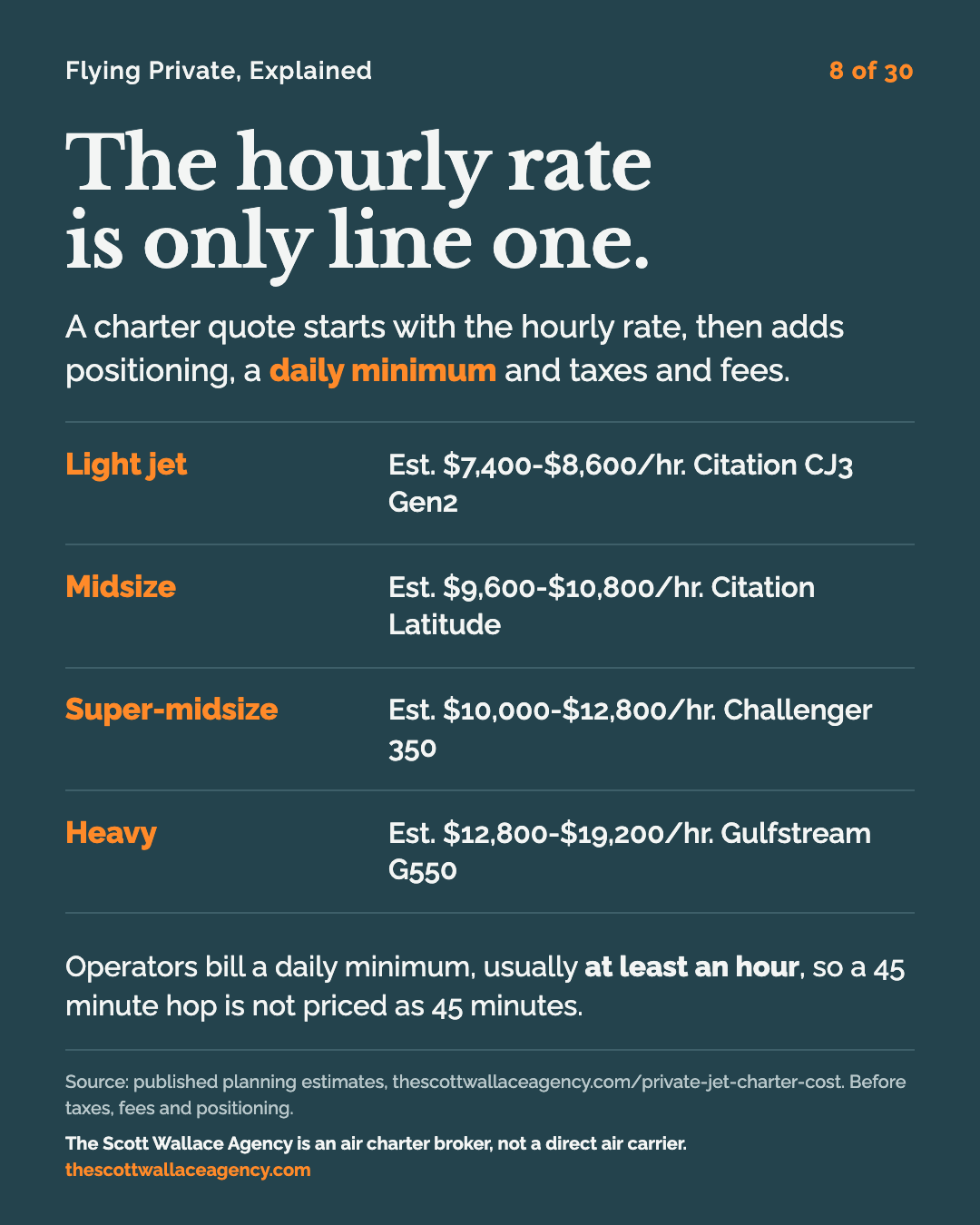
A 45 minute charter flight is usually billed as at least an hour. That is the operator's daily minimum, and it is one of four layers in every charter price.
The first layer is the hourly rate for the aircraft. Our published planning ranges, before taxes and fees:
- Light jet (Citation CJ3 Gen2): Est. $7,400 to $8,600 per hour
- Midsize (Citation Latitude): Est. $9,600 to $10,800 per hour
- Super-midsize (Challenger 350): Est. $10,000 to $12,800 per hour
- Heavy (Gulfstream G550): Est. $12,800 to $19,200 per hour
The second layer is positioning. If the aircraft has to fly empty to reach you, or to get home after dropping you off, those hours are part of the price. Day 9 covers why a one-way can cost close to a round trip.
The third layer is the daily minimum. Operators bill a minimum per day, usually at least an hour, so short trips are not proportionally cheaper than longer ones.
The fourth layer is taxes and fees: the 7.5 percent federal excise tax on a domestic trip, a per-passenger segment fee for each takeoff and landing, and airport fees. Day 10 covers the taxes and Day 11 the airport and crew costs.
Two quotes with the same hourly rate can land far apart once those layers are added, which is why I compare the all-in number and send every quote with the lines spelled out. If you want to see how a trip of your own would stack up, the estimator on our charter page works the same way.
Day 9of 30
Why a one-way can cost like a round trip
A one-way charter often pays for the aircraft's empty flights to reach you and to get home, so where the aircraft is based can move the price more than the route does.
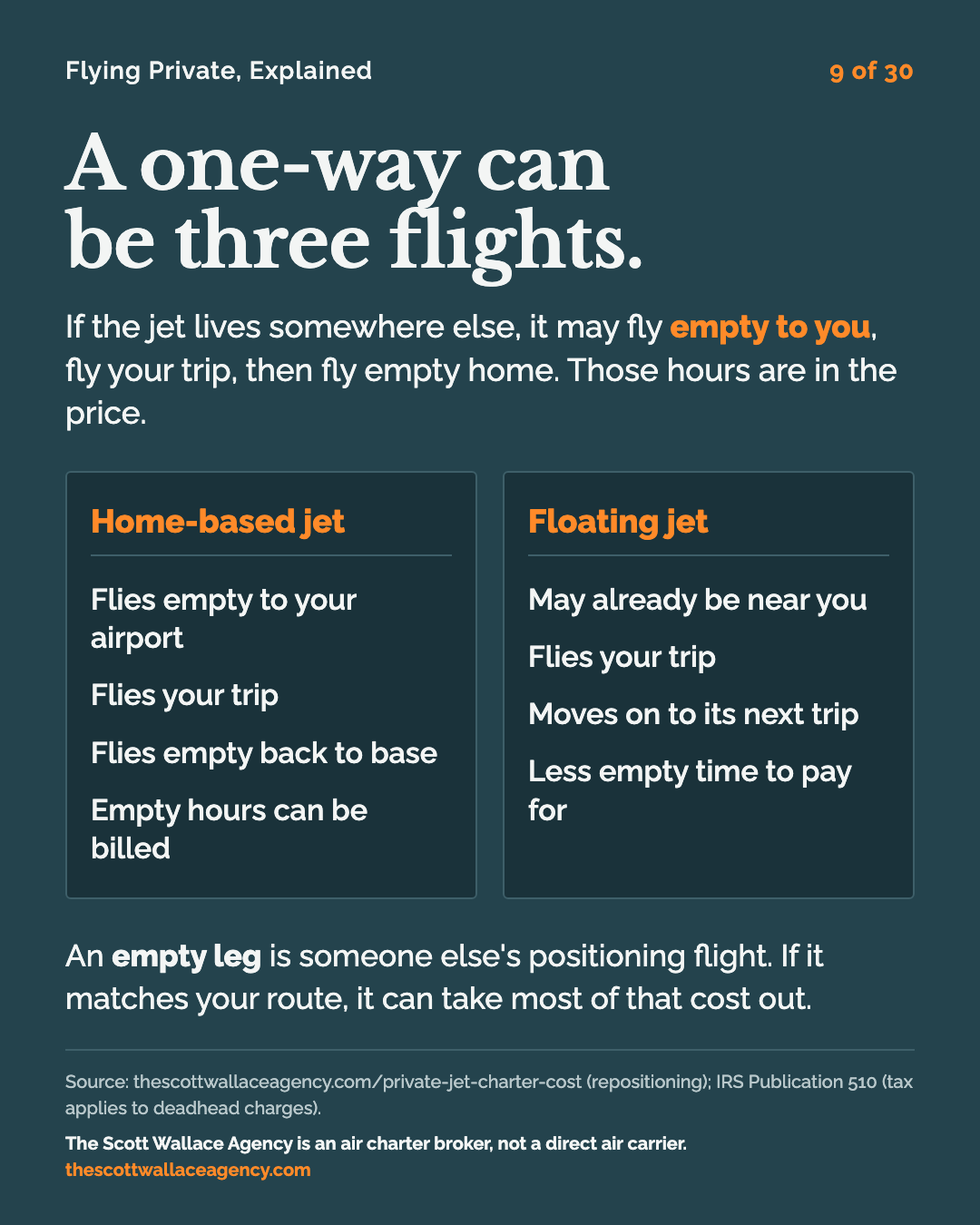
On a one-way charter, the airplane can fly three legs while you ride on one.
If the aircraft that fits your trip is based somewhere else, it flies empty to your airport, flies your trip, then flies empty back to its base. Those positioning hours are part of the price. That is why a one-way quote can come out close to a round trip, and why a round trip with a short stay on the ground is often more efficient than two separate one-ways.
The IRS treats those hours the same way. Publication 510 lists movement of aircraft in deadhead service as part of the amount the 7.5 percent tax applies to on a domestic trip.
There are two broad ways operators run their aircraft:
- Home-based: each aircraft lives at a fixed airport, flies the trip and comes home. Pricing can be very good when your trip starts near that base, and you may pay to bring it to you when it does not.
- Floating: aircraft reposition around the country and pick up trips wherever they end up, so one may already be near you. You may give up some consistency in which specific aircraft you get.
Neither is better every time. I source from both and look for the aircraft with the least empty flying for your dates.
The last piece is the empty leg. An empty leg is another trip's positioning flight, offered when the route is going that way regardless. When one matches your route and timing, it can take most of the positioning cost out. The catch is that its route and time are set by the other trip, and it can change if that trip changes.
Sources
Day 10of 30
The taxes on a charter
A domestic charter carries a 7.5 percent tax on the whole amount paid (positioning included) plus a per-passenger fee for every takeoff and landing, while an international trip is taxed per person instead.
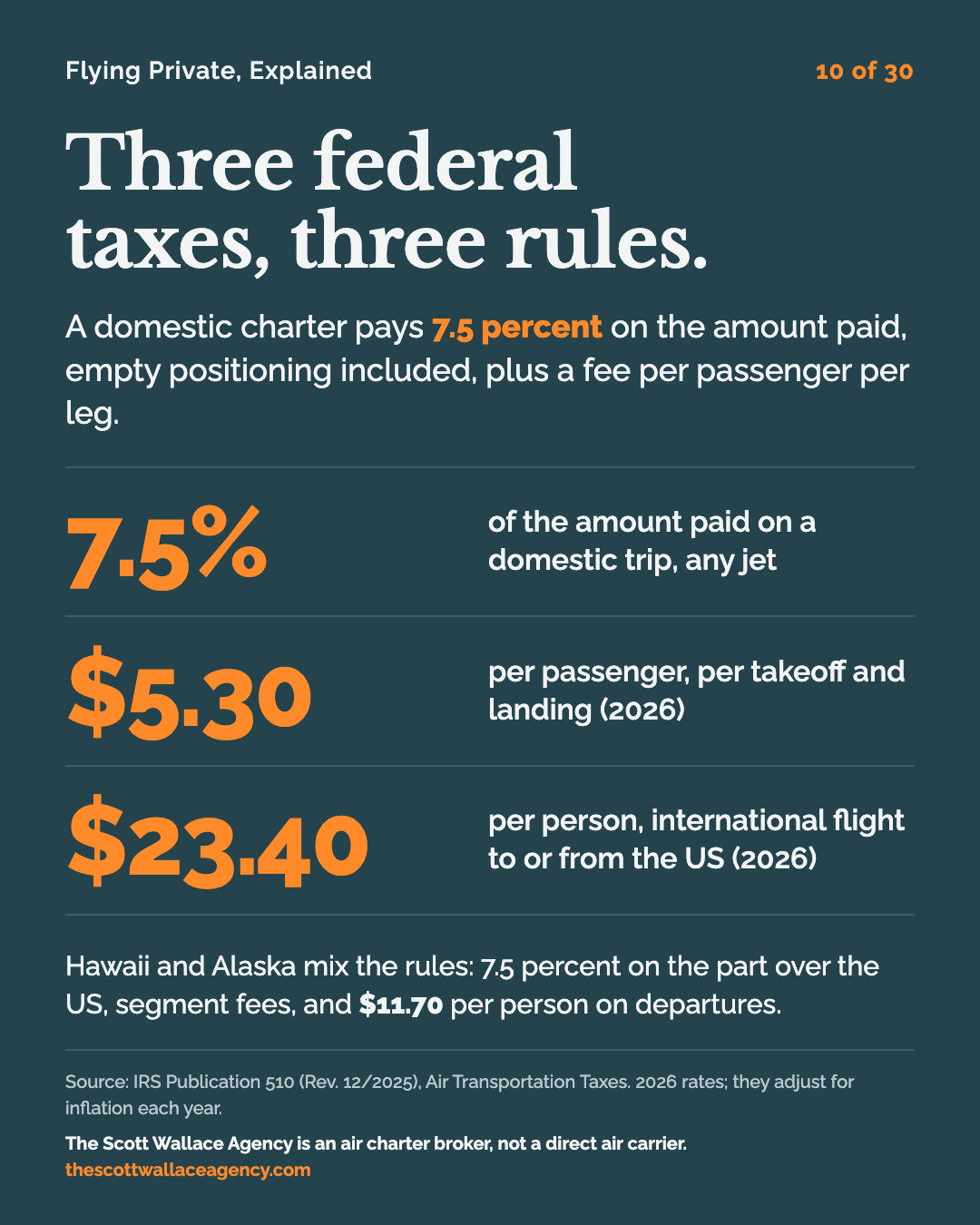
Three federal charges show up on a charter quote, and each follows a different rule. All figures below are from IRS Publication 510 (Rev. December 2025) and are the 2026 rates.
- Percentage tax, 7.5 percent. Applies to the amount paid for taxable transportation of people by air. The IRS includes movement of aircraft in deadhead service in that amount, so empty positioning flights are taxed like the rest of the trip. A round trip counts as two separate trips.
- Domestic segment tax, $5.30. A flat amount for each segment, which the IRS defines as one takeoff and one landing. On a charter it is multiplied by the number of passengers on board. Segments to or from an airport the IRS treats as rural are exempt.
- International air travel facilities tax, $23.40 per person. For international flights that begin or end in the United States.
The one sentence to remember on international trips: they are taxed per person rather than as a percentage of the price, because transportation that leaves the United States and its 225 mile zone in Canada and Mexico is generally not taxable transportation for the 7.5 percent.
Hawaii and Alaska sit in between. A trip from the continental US pays the 7.5 percent only on the part of the route in US airspace, plus segment fees, plus a reduced per-person tax of $11.70 that applies to departures only.
One common misunderstanding: the IRS exempts some aircraft of 6,000 pounds or less, but the taxes apply to every jet regardless of its weight.
The segment and international amounts adjust for inflation each year, so check the current figure on the IRS page for trips in a new year. I list each of these on the quote as its own line.
Day 11of 30
Airport and crew costs
Airport and crew charges such as landing fees, ramp and handling, hangar and crew overnights sit outside the hourly rate, and some airports publish theirs, like Aspen's landing fee by aircraft weight.
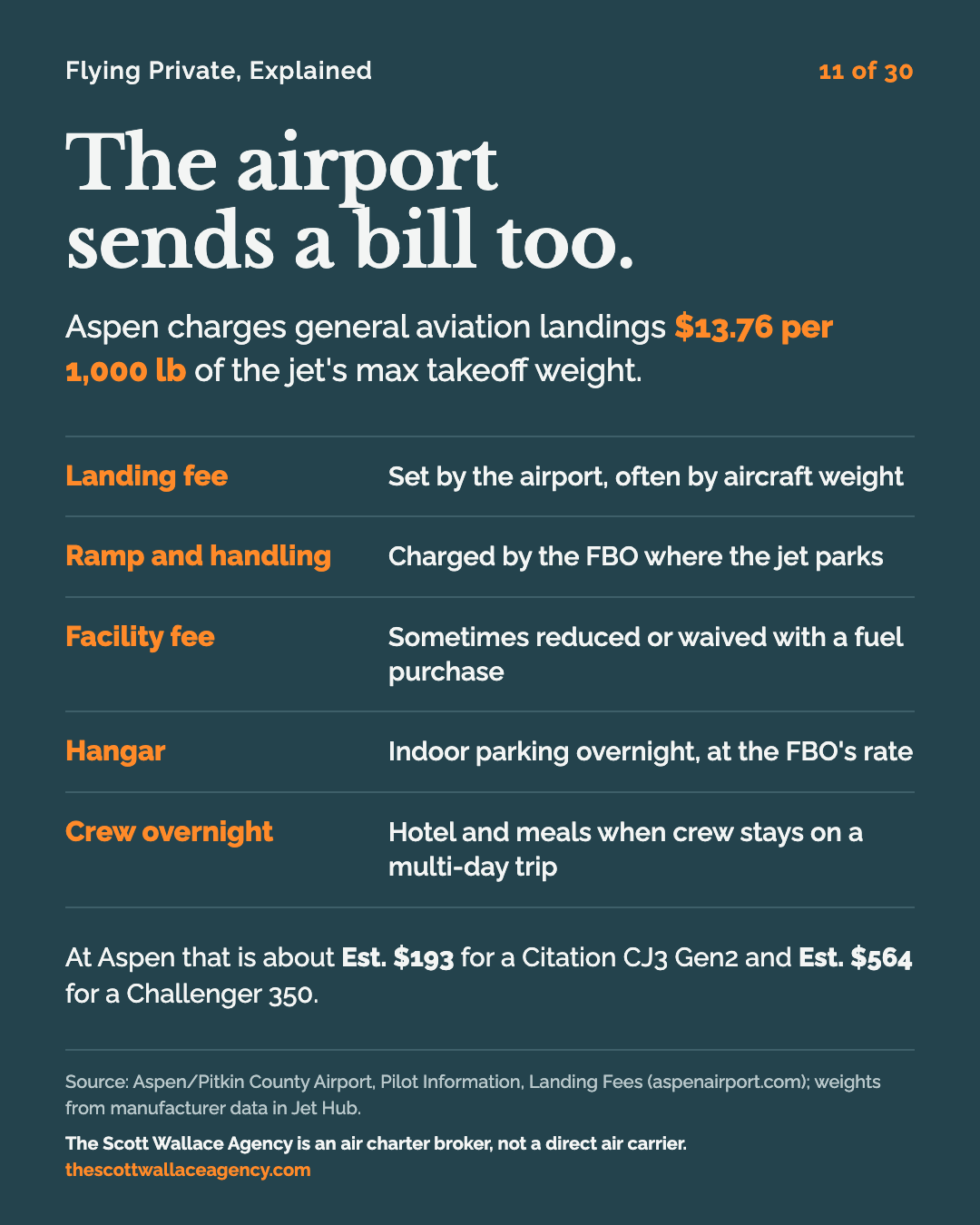
Aspen/Pitkin County Airport publishes its landing fee for general aviation aircraft: $13.76 per 1,000 pounds of maximum takeoff weight, rounded to the nearest thousand, collected at departure through the airport's billing contractor.
Worked out with manufacturer weights:
- Citation CJ3 Gen2 (light jet, 13,870 lb, rounds to 14,000): about Est. $193
- Challenger 350 (super-midsize, 40,600 lb, rounds to 41,000): about Est. $564
Landing fees are one of several costs that live outside the hourly rate:
- Ramp and handling, charged by the FBO (the private terminal) where the aircraft parks.
- Facility fees, which some FBOs reduce or waive when the aircraft buys fuel there.
- Hangar, if the aircraft sleeps indoors. In winter this can matter for another reason, covered on Day 12.
- Crew overnight, the crew's hotel and meals when the aircraft waits for you on a multi-day trip.
Each depends on the airport, the FBO and how long the aircraft stays, which is one reason two quotes into the same town can differ. Peak days at busy mountain and resort airports can add their own charges as well.
None of these should arrive as a surprise. On the quotes I send, they appear as their own lines or as named pass-throughs, so you know what could apply before you commit. If you are planning a trip into a specific airport, our airport guides list what to know before you go.
Day 12of 30
The winter line item: de-icing
Federal rules bar a charter takeoff with frost, ice or snow on the wings or control surfaces, so de-icing is a winter cost nobody can price until the morning of the flight.
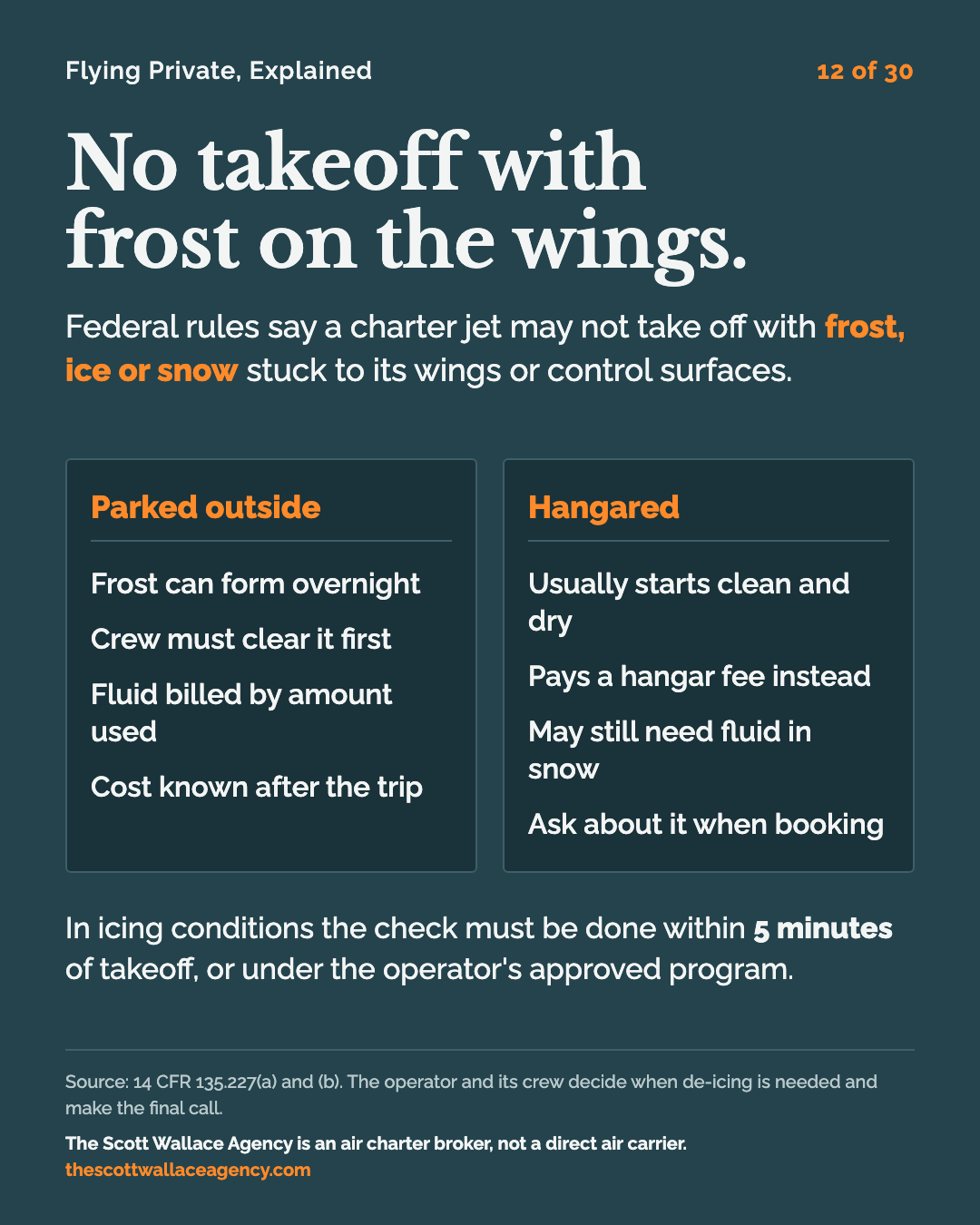
Under 14 CFR 135.227, no pilot may take off an aircraft with frost, ice or snow adhering to its wings, control surfaces, propellers, windshield, powerplant or key flight instruments.
When conditions are such that frost, ice or snow may reasonably be expected to stick, the rule adds one of three paths before takeoff: a pretakeoff contamination check within 5 minutes of beginning the takeoff, an approved alternative procedure, or an approved deicing and anti-icing program.
What that means for the bill:
- De-icing fluid is billed by the amount used, and the amount depends on the overnight temperature, the morning's weather and the size of the aircraft.
- Nobody can price it in advance. On a quote it appears as a possible charge, and the actual figure usually arrives after the trip.
- A heated hangar the night before often keeps the aircraft clean and dry on a cold clear morning. It costs a hangar fee instead, and the aircraft can still need fluid if snow is falling as it taxis out.
This is one of the few charges I cannot give you a number for ahead of time, so I would rather you know about it before your first winter trip than after.
The operator and its crew decide whether the aircraft needs de-icing, and they make the final call on every flight.
Day 13of 30
The extras
Wi-Fi, catering, ground transportation, pets and cancellation terms are set operator by operator and tail by tail, so each one should be asked about and written down before booking.
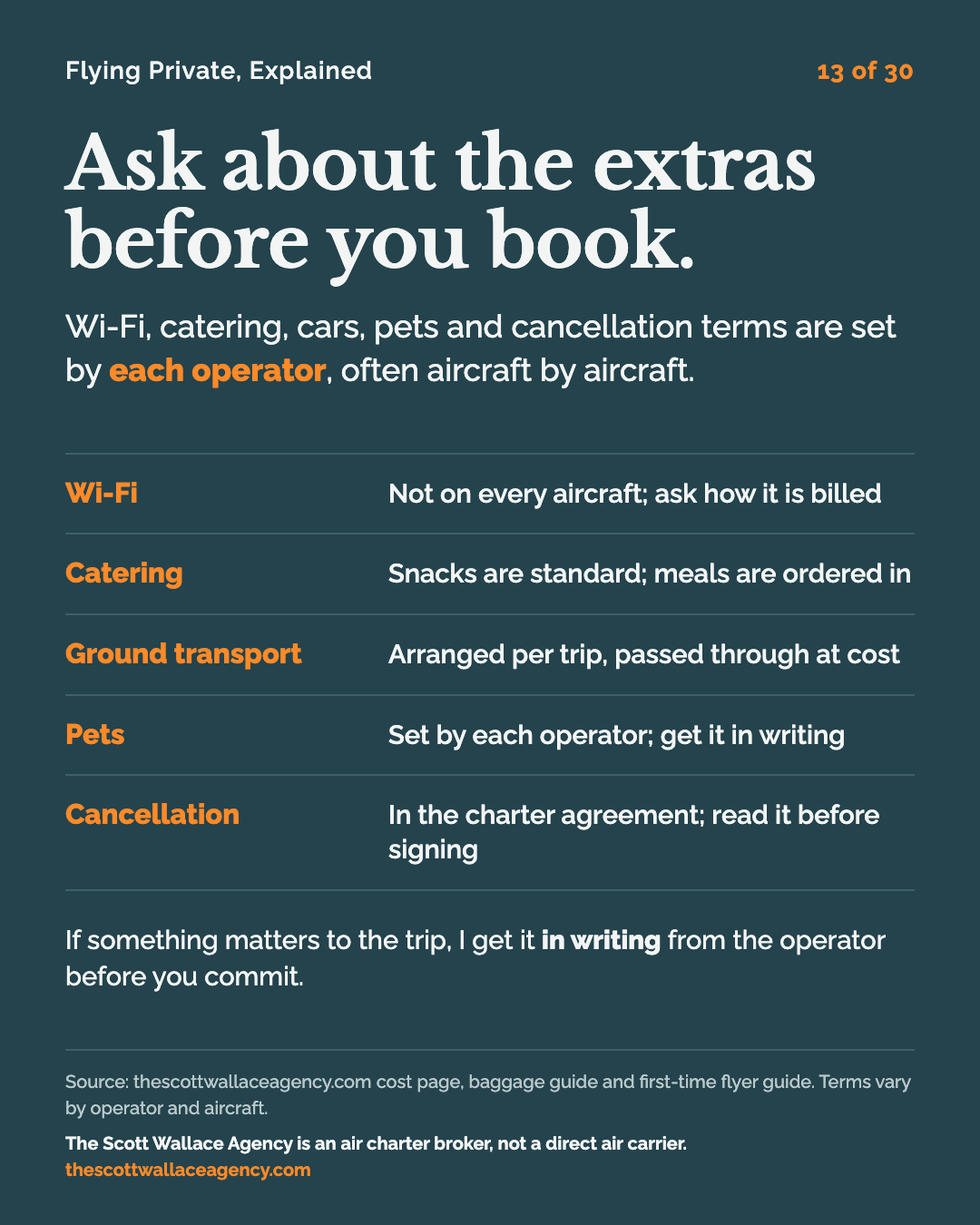
Wi-Fi is not on every charter aircraft, and on some it is billed by how much data you use. If you plan to work in the air, ask whether the specific aircraft has it, what kind it is and how it is charged, and count on it only once it is confirmed.
The other extras follow the same pattern. They are set by each operator, often aircraft by aircraft:
- Catering. Most aircraft carry drinks and light snacks. Anything more is ordered in and loaded before departure, so deciding a day ahead helps. On smaller jets with no galley or cabin attendant, food is set up to be easy to eat rather than plated and served.
- Ground transportation. Arranged per trip. Like catering and de-icing, it is a charge the operator can only set for the day, so it appears on the quote as a possible pass-through at cost.
- Pets. Most operators welcome pets in the cabin, but acceptance is operator by operator and tail by tail. I confirm a pet in writing with the specific operator before you book. International trips with a pet need paperwork and lead time.
- Cancellation. Every operator sets its own terms, and they are written into the charter agreement. Read that section before you sign, and ask me about anything that is unclear.
None of these are hidden charges. They depend on the aircraft and the operator, so the answer has to be asked for each trip. If one of them matters to you, tell me at the start and I will get the answer in writing before you commit.
Sources
Day 14of 30
Your turn: which quote is cheaper?
Comparing charter quotes means comparing the all-in trip: a lower headline price can leave out de-icing and Wi-Fi and add a fuel stop with its own fees, time and taxes.

The setup. Same passengers, same dates, January, leaving a mountain airport. Quote A is nonstop on a slightly larger jet, with Wi-Fi stated and de-icing listed as a possible charge. Quote B is a few thousand dollars less, on a smaller jet that needs one fuel stop, and says nothing about de-icing or Wi-Fi.
My answer: you cannot tell from the headline price, and that is the point. Quote B may still be cheaper, but it is not yet a like-for-like number. Here is what I would ask first.
- De-icing. In January at a mountain airport, the aircraft may need it whichever quote you pick (Day 12). Quote A lists it. Quote B is silent on it, so you do not yet know whether it will appear on the bill.
- The fuel stop is a whole extra takeoff and landing. Under IRS Publication 510 a segment is one takeoff and one landing, and on a charter the $5.30 segment tax (2026) is charged per passenger per segment, unless the stop is at an airport the IRS treats as rural. The stop can also bring its own landing and handling fees (Day 11), and more flight time at the hourly rate.
- Time. A fuel stop adds time on the ground and in the air. If the trip is about arriving ready for a meeting, that has a value of its own.
- Wi-Fi. If you plan to work on board, Quote B has not said whether the aircraft has it or how it is billed (Day 13).
What I would do: ask the broker or operator behind Quote B to state de-icing, Wi-Fi and every stop-related fee in writing, then compare the two all-in numbers. If B is still lower and the stop does not hurt the trip, it may be the right choice.
The operator and its crew make the final call on routing, fuel stops and de-icing on every flight.
Day 15of 30
Range is not one number
A brochure range is often a ferry figure with full tanks and no passenger load; the King Air 260 drops from 1,720 nm in the brochure to 1,038 nm with four passengers, and winds and required reserve fuel come out of what is left.
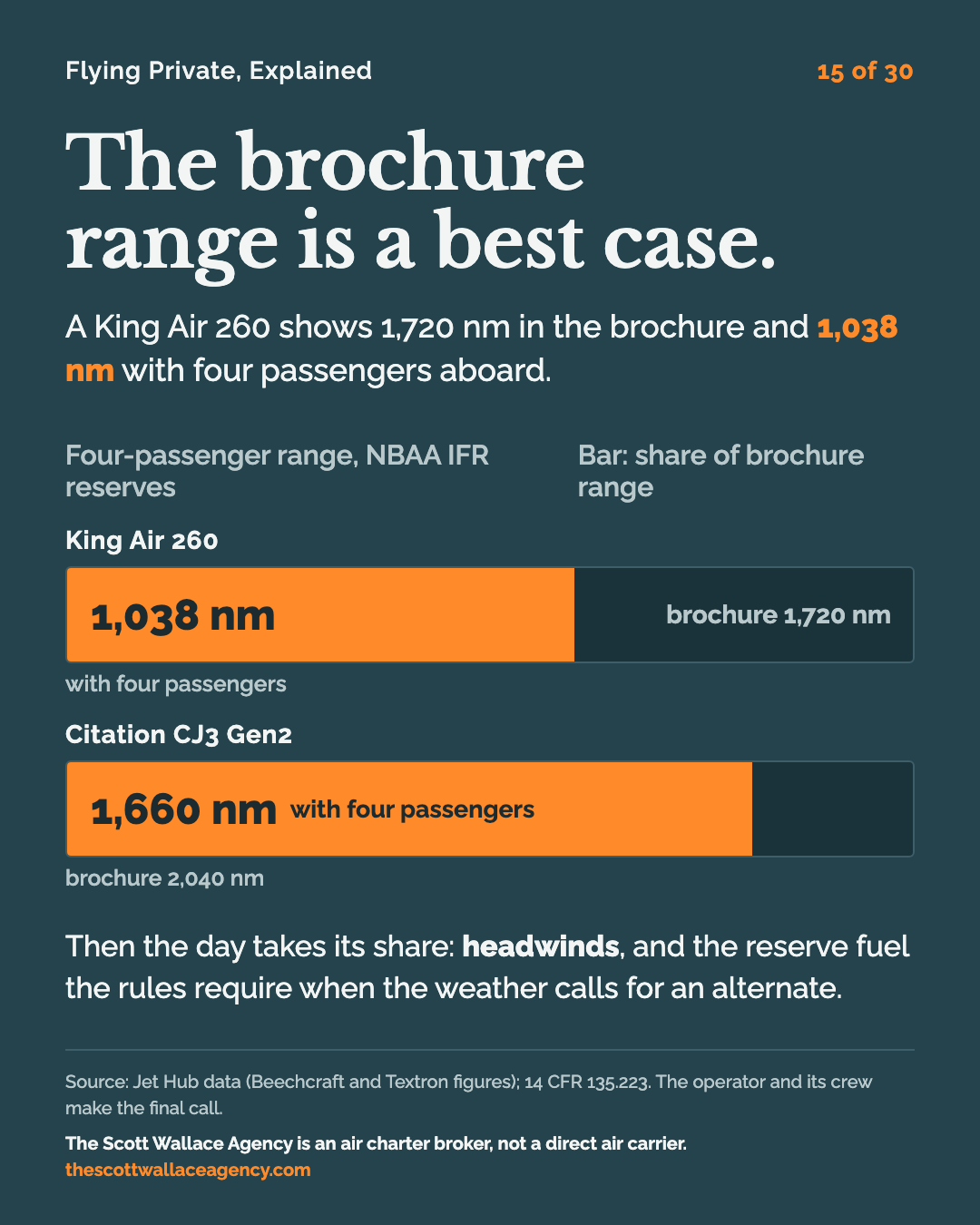
The range in an aircraft brochure answers a narrow question: how far can this airplane go under one specific set of assumptions. For the King Air 260, Beechcraft's 1,720 nm figure is a ferry mission: full fuel, no passenger load, long-range cruise, a standard day, zero wind, and NBAA IFR reserves with a 100 nm alternate.
Put four passengers aboard and the planning figure in the Jet Hub data I use drops to 1,038 nm. That is about 60 percent of the brochure number, for the same airplane. People and bags use up weight that would otherwise go to fuel, and fuel is range.
The gap is different for every type. A Citation CJ3 Gen2 shows 2,040 nm in its brochure and 1,660 nm with four passengers. That is why I compare aircraft on the four-passenger number and treat the brochure figure as a ceiling.
After that, the actual day takes its share:
- Wind. A westbound winter trip can fly into a headwind the whole way, and the same route eastbound rides a tailwind.
- Reserve fuel. When the forecast calls for an alternate airport, 14 CFR 135.223 requires fuel to reach the destination, fly to the alternate, and then fly 45 more minutes. That fuel is carried, so it never becomes range.
- Cruise speed. Brochure figures usually assume a slower long-range cruise.
A brochure figure is a fine place to start comparing aircraft. The operator and its crew run a real calculation for your date, with your passengers, your bags and the forecast winds, and they make the final call on whether the trip flies nonstop. My job as a broker is to know which aircraft are worth asking about so the answer is not a surprise on the day you fly.
Day 16of 30
Seats full or tanks full
Every aircraft has a maximum takeoff weight, and on most aircraft full seats, full bags and full tanks together exceed it, so more people and bags means less fuel and less range; bags also have their own weight limit and must fit through the door.
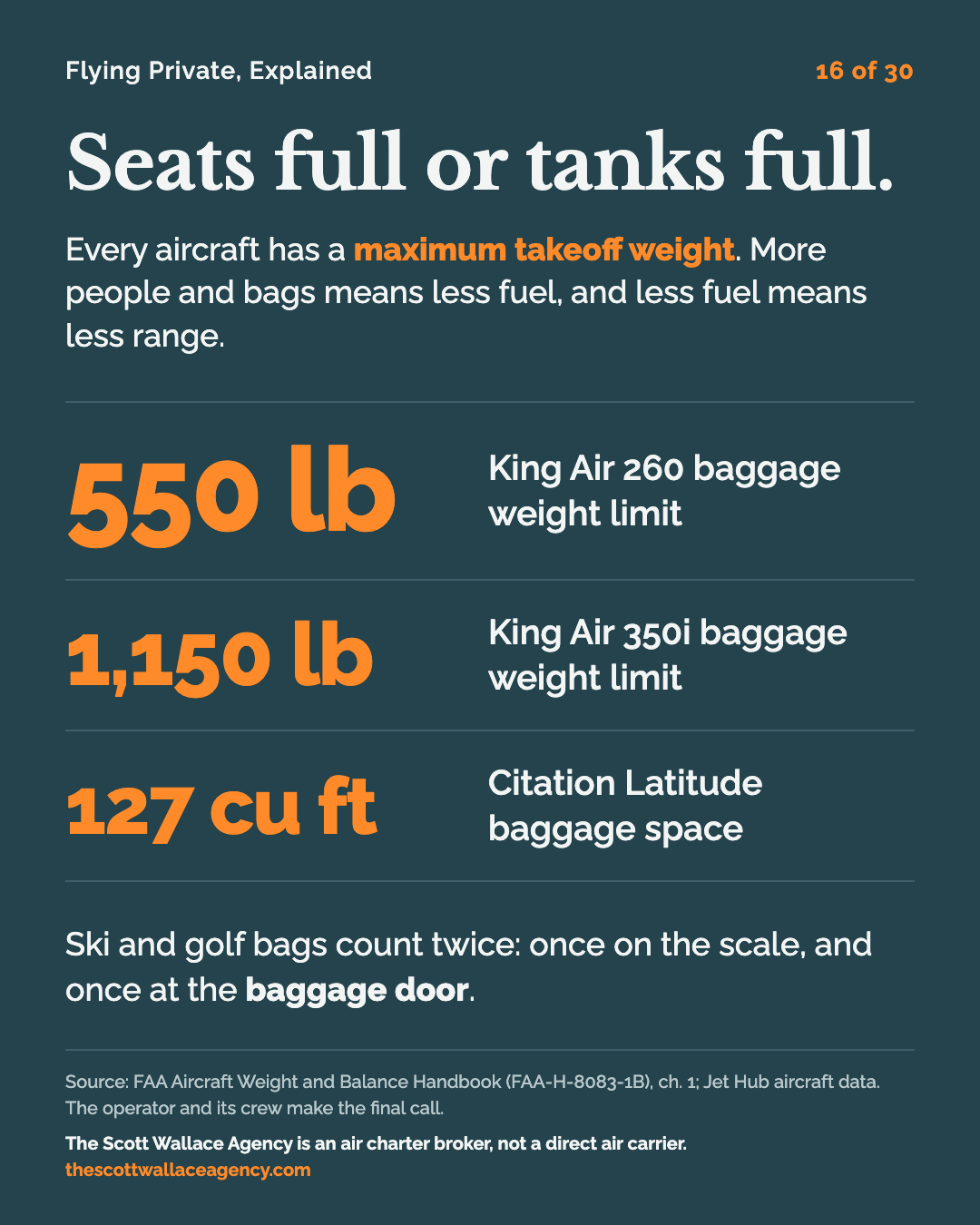
Every aircraft has a maximum takeoff weight, set when it is certificated. Inside that one number, the operator has to fit the airplane itself, the crew, the passengers, the bags and the fuel.
The FAA's Aircraft Weight and Balance Handbook is blunt about how that works on most modern aircraft: with every seat filled, the baggage compartment full and every tank full, the airplane is overloaded. For maximum range, occupants or baggage have to stay behind. For maximum load, the range has to come down. The same handbook lists what an overweight airplane does: a longer takeoff run, a weaker climb and a longer landing roll.
Bags carry limits of their own, and they vary a lot by type:
- King Air 260: baggage rated for 550 lb
- King Air 350i: baggage rated for 1,150 lb
- Citation Latitude: 127 cubic feet of baggage space
Volume and weight are separate limits, and there is a third one people forget: the door. A compartment can have enough cubic feet and still refuse a long ski bag or a golf bag with an oversize driver if it will not pass through the opening. Ski and golf bags count twice, once on the scale and once at the door.
That is why the first questions I ask are how many people, how many bags, and what kind. A group of six with carry-ons and the same six with ski gear can point to two different aircraft. Measuring the long items before booking takes a minute and keeps the trip from being repacked at the FBO.
The operator and its crew calculate the weight and balance for every flight and make the final call on what goes. My job is to match the aircraft to the load before price comes into it.
Day 17of 30
The 60 percent rule
Under the charter landing rules, most charter jets have to be able to land and stop within 60 percent of the runway (more if the runway may be wet), so Aspen's 8,006 ft runway plans as 4,804 ft dry and about 4,177 ft wet.
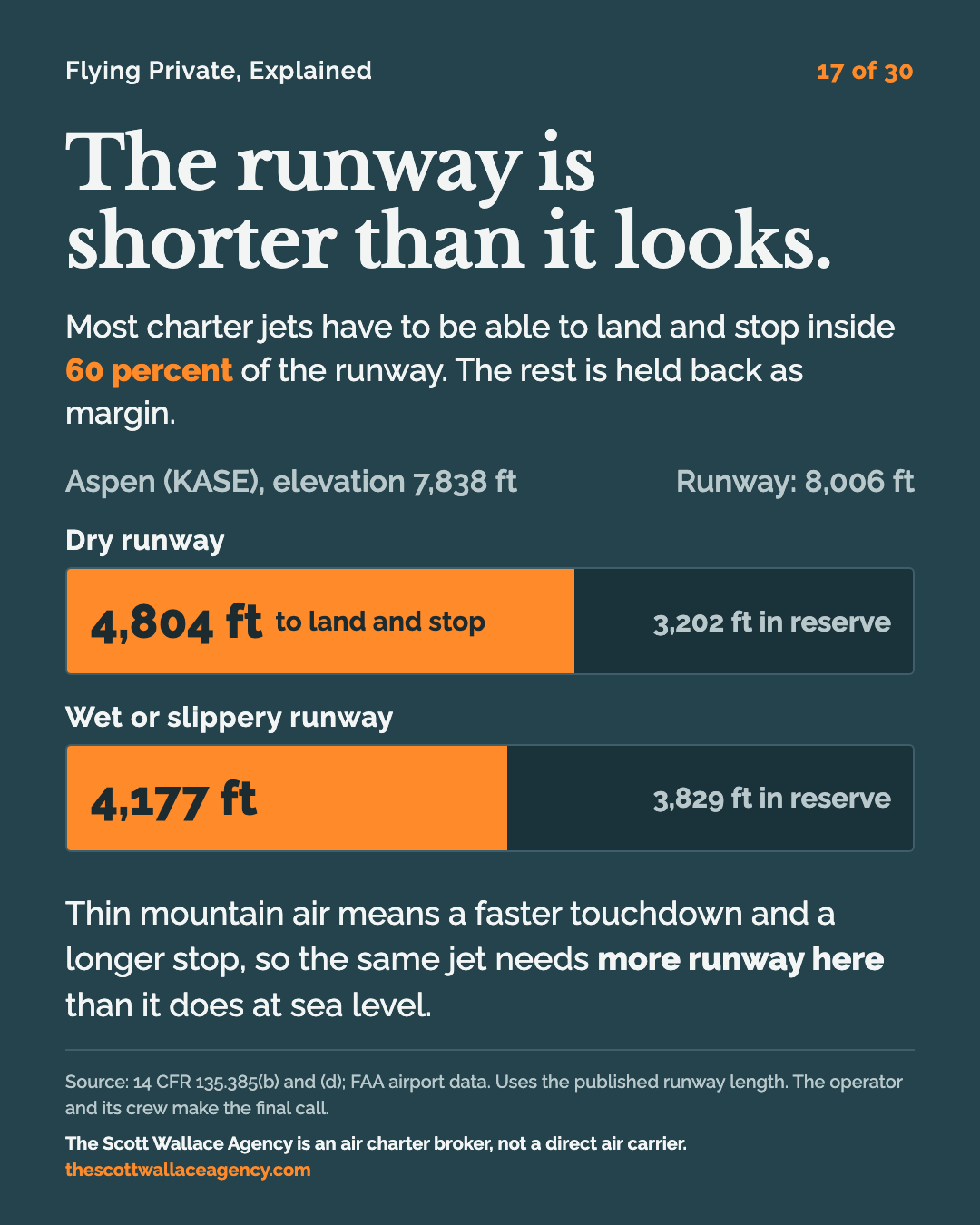
Aspen's runway is 8,006 feet long. For most charter jets, the planning number is 4,804 feet.
Under 14 CFR 135.385(b), before a covered charter airplane takes off, the operator has to show that at its expected landing weight it can make a full stop at the destination within 60 percent of the effective runway length. The other 40 percent is held back for the day that is not perfect.
If the forecast says the runway may be wet or slippery when the jet arrives, paragraph (d) raises the requirement: the runway has to be at least 115 percent of the dry planning length. At Aspen that works out to about 4,177 feet of planned stopping distance.
Elevation adds to it. Aspen sits at 7,838 feet. In thinner air the airplane touches down at the same indicated airspeed but a higher true speed, so it needs more distance to stop.
Put those together and you get a common surprise: the jet that works from Dallas to Scottsdale does not work into Aspen with six people and ski bags. Same airplane, different numbers to meet.
Two footnotes:
- Under paragraph (f), some on-demand operators hold FAA approval for a Destination Airport Analysis program that lets them plan to 80 percent.
- The rule uses the runway's effective length, measured from where the obstacle clearance plane meets the runway. At some airports that is shorter than the published length. The figures here use the published length.
The operator and its crew run these numbers and make the final call on every flight. My job as a broker is knowing which aircraft are worth asking about.
Sources
Day 18of 30
Dry, wet, contaminated
Airports report each third of a runway as a code from 6 (dry) to 0 (nil braking); a jet planned into a possibly wet runway needs 15 percent more runway under 135.385(d), and FAA guidance asks the crew to recheck on arrival and add a margin of at least 15 percent.
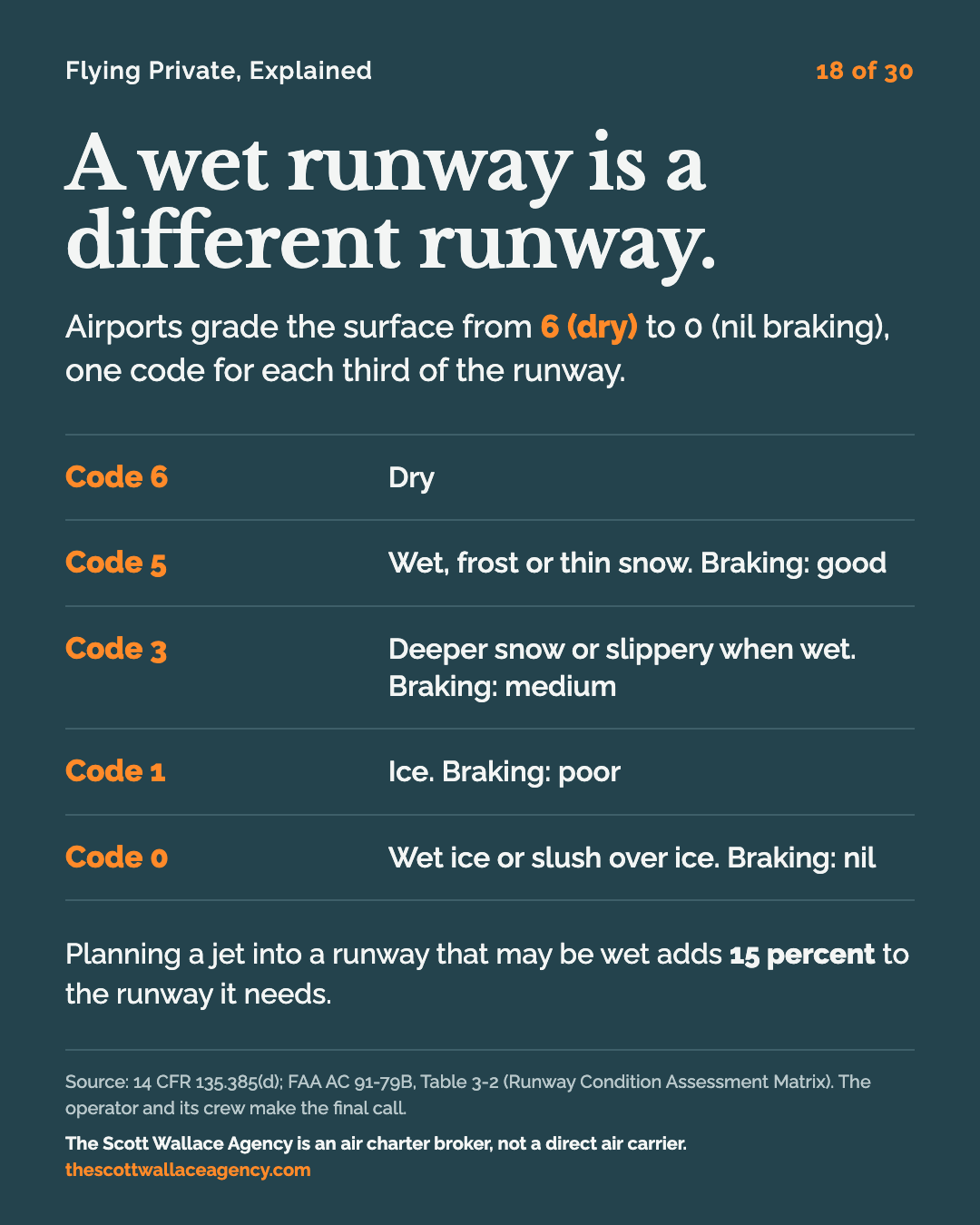
Airports describe runway surfaces with a Runway Condition Code, a number from 6 to 0. The FAA defines it in the Runway Condition Assessment Matrix (RCAM), published in AC 91-79B:
- 6: dry
- 5: frost, wet (up to 1/8 inch of water), or 1/8 inch or less of slush or snow. Braking: good
- 4: compacted snow at minus 15 C or colder. Braking: good to medium
- 3: a runway that is slippery when wet, deeper dry or wet snow, or compacted snow warmer than minus 15 C. Braking: medium
- 2: more than 1/8 inch of water or slush. Braking: medium to poor
- 1: ice. Braking: poor
- 0: wet ice, slush over ice, or snow over ice. Braking: nil
The airport reports one code for each third of the runway, so a crew can hear something like 5/5/3.
Two margins sit on top of the codes. At the planning stage, 14 CFR 135.385(d) says that if the forecast shows the destination runway may be wet or slippery, a turbojet needs a runway at least 115 percent of its dry planning length. Then, at the time of arrival, AC 91-79B tells crews to get the current report, work out the landing distance for the runway as it is, and add a safety margin of at least 15 percent. The first is a rule. The second is FAA guidance that operators build into their procedures.
This is why winter trips carry more uncertainty than summer ones. Between booking and departure the aircraft stays the same while the runway report can change.
The operator and its crew run these numbers and make the final call on every flight. My part is talking through a backup plan ahead of time, often a lower or longer runway nearby, so a change on the day is a short conversation.
Sources
Day 19of 30
Getting out is harder than getting in
A charter jet's takeoff weight is capped so it could stop on the runway if an engine failed at decision speed, and for large transport category jets so its one-engine climb path clears every obstacle; heat, elevation and weight all lower that allowed weight.
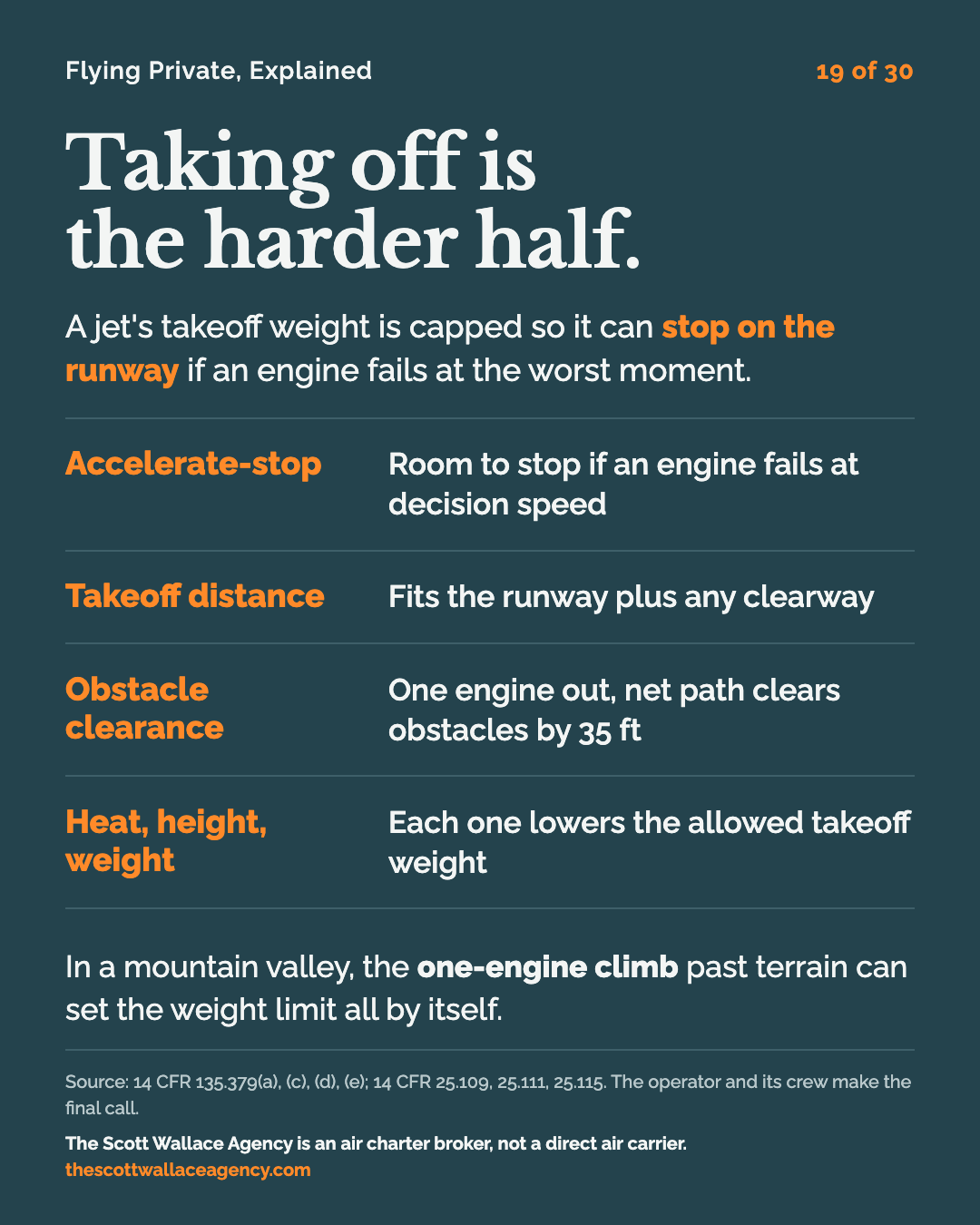
At a mountain airport, the takeoff often sets the weight limit for the whole trip.
Under 14 CFR 135.379(a), a covered jet cannot take off heavier than its flight manual allows for that airport elevation and that temperature. Paragraph (c) then adds three runway checks:
- The takeoff run must fit the runway.
- The takeoff distance must fit the runway plus any clearway.
- The accelerate-stop distance must fit the runway plus any stopway.
Accelerate-stop is the one worth understanding. Under the certification rule (14 CFR 25.109), it is the distance to accelerate, have the critical engine fail, reject the takeoff at the decision speed, and come to a full stop, plus a small time allowance. In plain words: room to stop on the runway if an engine fails at the worst moment. A heavier airplane reaches that moment faster and needs more room to stop.
For a large transport category jet, paragraph (d) adds a climb test. The net takeoff flight path is the climb with the critical engine inoperative (25.111), reduced by a built-in margin of 0.8 percent of climb gradient for a twin (25.115). That path has to clear every obstacle by at least 35 feet vertically, or by 200 feet horizontally inside the airport boundary and 300 feet beyond it. In a valley with rising terrain, this can be the number that limits the takeoff.
Paragraph (e) requires the operator to correct all of it for the runway used, elevation, runway slope, temperature, wind, and a wet runway where the flight manual sets wet limits. Heat and altitude both thin the air, and weight makes every distance longer, so all three cut into what the airplane can carry.
The operator and its crew run these numbers and make the final call on every flight. My job is to raise the departure question before booking, so a weight cut or a fuel stop is planned rather than discovered.
Sources
Day 20of 30
Hot and high
Density altitude is pressure altitude corrected for temperature, the altitude the airplane actually performs at; a standard day at Aspen's 7,838 ft is already about 0 C, so a warmer day makes the airplane behave as if the field were even higher, with longer takeoff and landing rolls and a weaker climb.
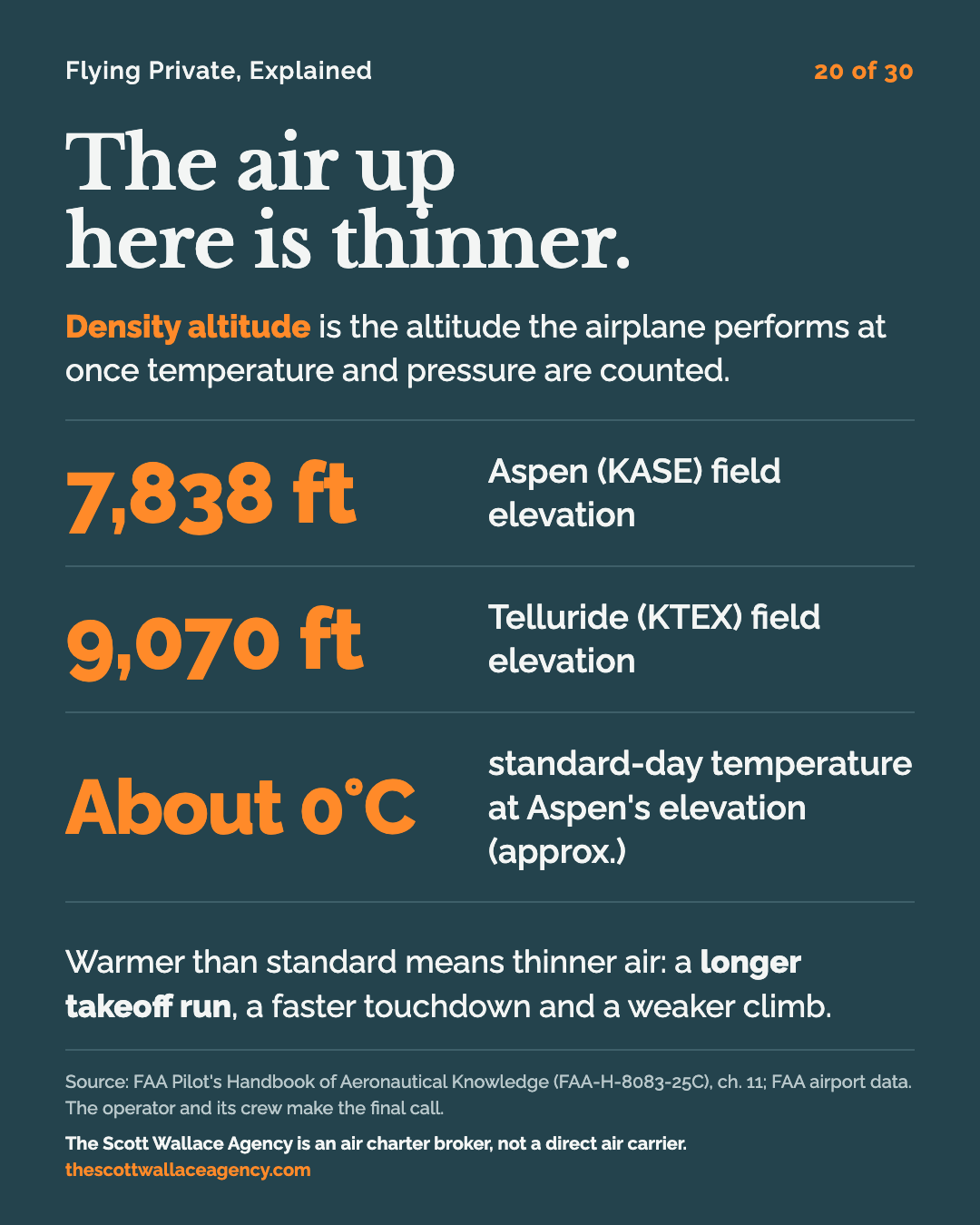
What changes an airplane's performance is how thick the air is, and pilots measure that with density altitude.
The FAA's Pilot's Handbook of Aeronautical Knowledge defines density altitude as pressure altitude corrected for nonstandard temperature. When density altitude is high, the air is thin, and the handbook lists the conditions that drive it up: high elevation, low barometric pressure, high temperature and high humidity.
The standard atmosphere cools about 2 degrees Celsius per 1,000 feet from 15 C at sea level. At Aspen's field elevation of 7,838 feet, that puts a standard day at about 0 C (approximate, from the standard lapse rate). Any day warmer than that, and the airplane performs as if the field were higher than it is. Telluride starts higher still, at 9,070 feet.
What thin air does, in the handbook's terms:
- Takeoff: a higher takeoff speed and less thrust, so a longer takeoff run.
- Landing: the same indicated airspeed but a higher true speed over the ground, so a longer landing roll.
- Climb: weaker, which matters most where terrain rises around the airport.
This connects the rest of the week. Density altitude stretches the landing distance from Day 17, the stopping distance from Day 19, and shrinks the climb margin that mountain departures depend on. On a hot summer afternoon the answer can be fewer bags, less fuel, an earlier departure or a different airport. On a cold winter morning the same trip often has more room.
The operator and its crew calculate density altitude for the actual day and make the final call on every flight. My job is to raise it when the trip is planned.
Day 21of 30
Your turn: six skiers to Aspen
Ranking aircraft for a real trip means checking range against the actual load, baggage space and door, and the destination's rules together; for six people and six ski bags from Dallas Love Field to Aspen (about 618 nm), the Citation Latitude has the most room to spare and the CJ3 Gen2 the least.
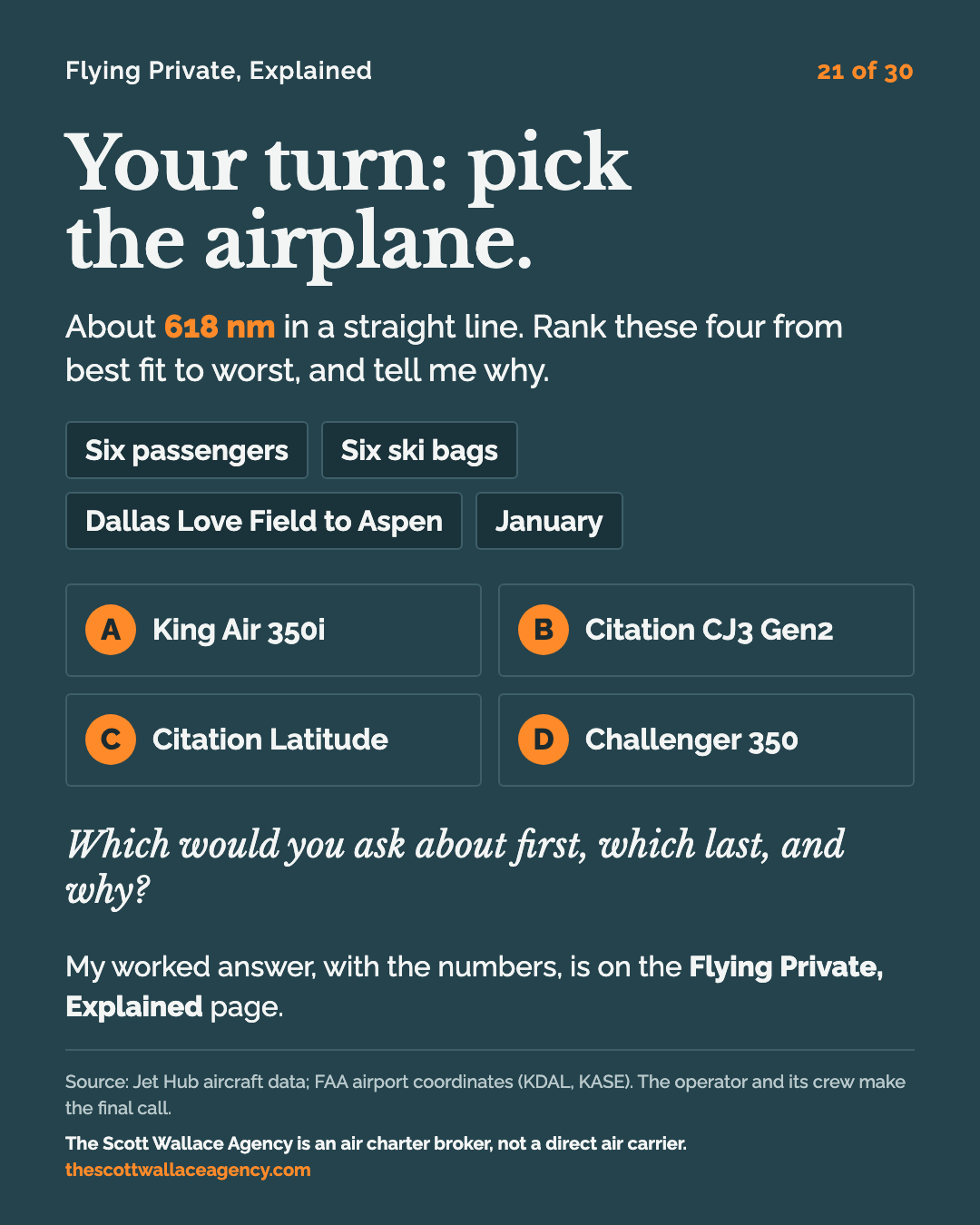
The trip: six passengers and six ski bags, Dallas Love Field (KDAL) to Aspen (KASE) in January. The great circle distance is about 618 nm, computed from the FAA airport coordinates.
Range. All four are rated well past 618 nm: King Air 350i 1,714 nm and Citation CJ3 Gen2 1,660 nm with four passengers, Citation Latitude 2,700 nm with four, and Challenger 350 3,200 nm on a figure Bombardier publishes for eight passengers. Six people and ski gear weigh more than the four-passenger basis, so real margin is smaller than those numbers suggest, but none of these sits near the edge on paper. Winds and reserve fuel (Day 15) come out of it on the day.
Seats. The Jet Hub data lists the charter cabins at eight for the King Air 350i, CJ3 Gen2 and Challenger 350, and nine for the Latitude.
Bags, the deciding factor. Baggage space in the Jet Hub data: Citation Latitude 127 cu ft, Challenger 350 106 cu ft, King Air 350i 71.3 cu ft, CJ3 Gen2 65 cu ft. Six ski bags is a volume question and a door question (Day 16).
My ranking, on fit and margin:
- First: Citation Latitude. The most baggage space of the four, a stand-up cabin, and range far beyond the trip. Textron flight-tested it at Telluride, and it is a regular at Aspen.
- Second: Challenger 350. More cabin than this group needs and less bag space than the Latitude, though still plenty, and a strong record into Aspen.
- Third: King Air 350i. Rated strong for Colorado mountain airports, with a 1,150 lb baggage rating, but 71.3 cu ft is tighter for six ski bags.
- Last: Citation CJ3 Gen2. A strong mountain performer with the least bag space here (65 cu ft) and six of its seats filled. It can still be the answer if the skis measure right, so I would ask with the bag dimensions in hand.
All four still have to meet this week's rules at Aspen in January: the landing limits (Day 17), the runway report (Day 18), and the departure (Day 19). The operator and its crew run those numbers for the actual day and make the final call.
Day 22of 30
Aspen and Telluride: can't versus shouldn't
Aspen bars any aircraft with a wingspan over 95 feet, so some large jets are ruled out by rule, while others fit the rule but are a poor choice because of altitude, runway and the day's temperature.
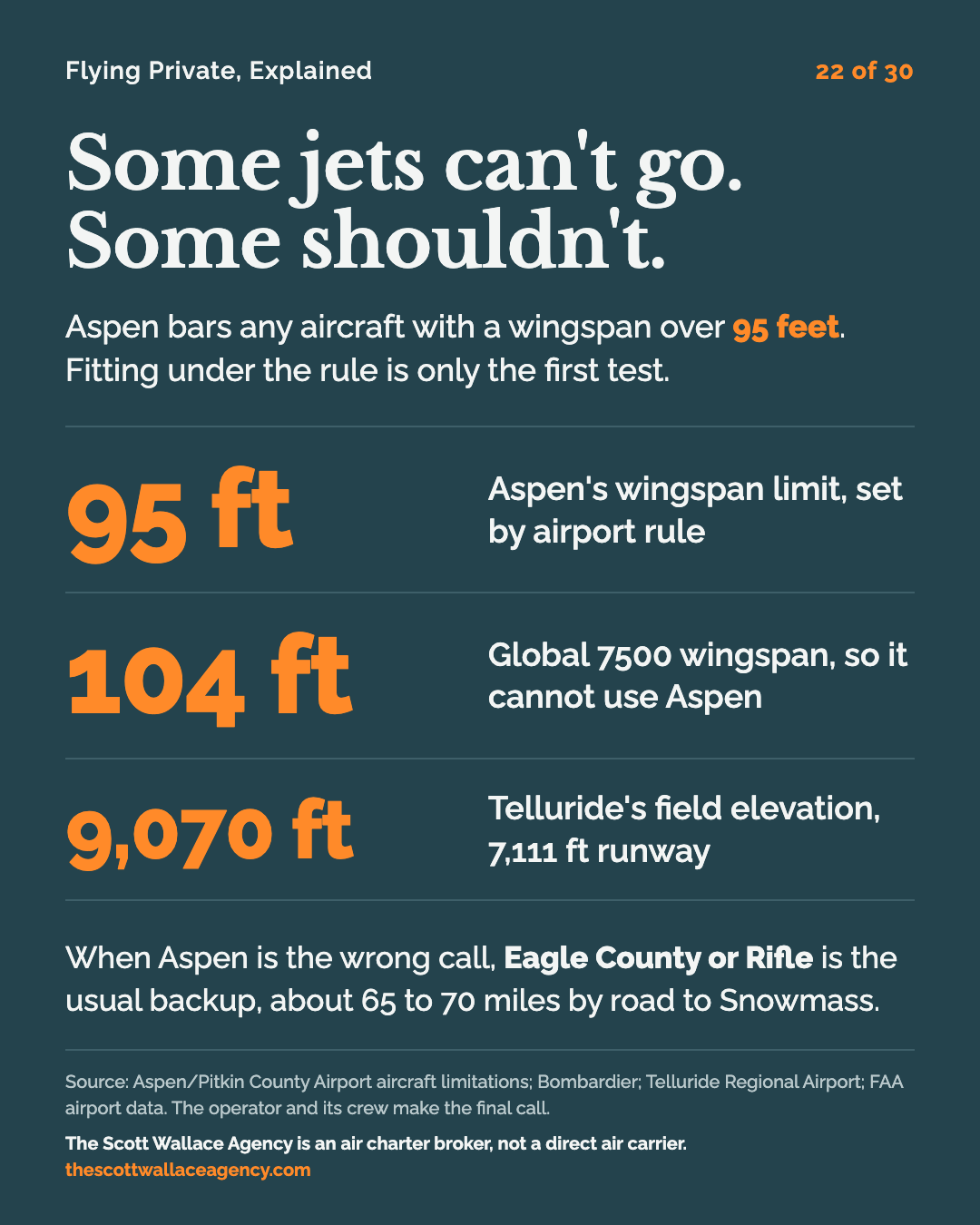
Aspen/Pitkin County Airport publishes a short list of aircraft that may not use the field at all. Two lines matter for private jets: no aircraft with a tip-to-tip wingspan over 95 feet, and none with a maximum landing weight over 100,000 pounds on dual wheels. The airport is also closed from 11 pm to 7 am, with no departures after 10:30 pm.
That is the can't list. The Bombardier Global 7500 spans 104 feet and the Gulfstream G700 spans 103 feet, so under the current rule both are out. A trip planned in one of those aircraft lands at Eagle County (KEGE) or Rifle (KRIL) and finishes by car. Aspen's own airport site puts each at roughly 65 to 70 miles by road from Snowmass.
Then there is the shouldn't list. A Global 6000 spans 94 feet, so it fits, but it needs about 6,476 feet to take off at sea level. Aspen's single runway is 8,006 feet long at 7,838 feet of elevation, and thin air stretches every takeoff and landing. On a warm day the honest answer is often fewer passengers, less fuel, or Eagle County.
The aircraft my planning notes rate strongest for Aspen and Telluride are smaller ones:
- Citation CJ3 Gen2 and Phenom 300E, the benchmark light jets for these fields
- King Air 350i, a twin turboprop with a 3,300 foot sea-level takeoff distance
Telluride Regional (KTEX) is higher again: 9,070 feet, a 7,111 foot runway, closed nightly from 9 pm to 6 am, no snow removal at night, and an airport caution that density altitude can exceed 11,000 feet. There the runway is rarely the only limit; climbing out through the surrounding terrain matters just as much. Montrose and Eagle County are the usual fallbacks.
All of this is planning guidance. The operator and its crew run the performance numbers for your group, your bags and your day, and they make the final call on every flight.
Sources
- Aspen/Pitkin County Airport, aircraft limitations (opens in a new tab)
- Aspen/Pitkin County Airport, noise and curfew (opens in a new tab)
- Aspen/Pitkin County Airport, travel options during the 2027 closure (alternate airport distances) (opens in a new tab)
- Telluride Regional Airport, pilot information (opens in a new tab)
- Bombardier Global 7500 specifications (opens in a new tab)
- Gulfstream G700 specifications (opens in a new tab)
Day 23of 30
Turboprops: short runways, short hops
A King Air 260 takes off in about 2,111 feet against 3,180 for a Citation CJ3 Gen2, which is why turboprops win on short and mountain runways, and why they lose on speed, long legs and climbing over weather.
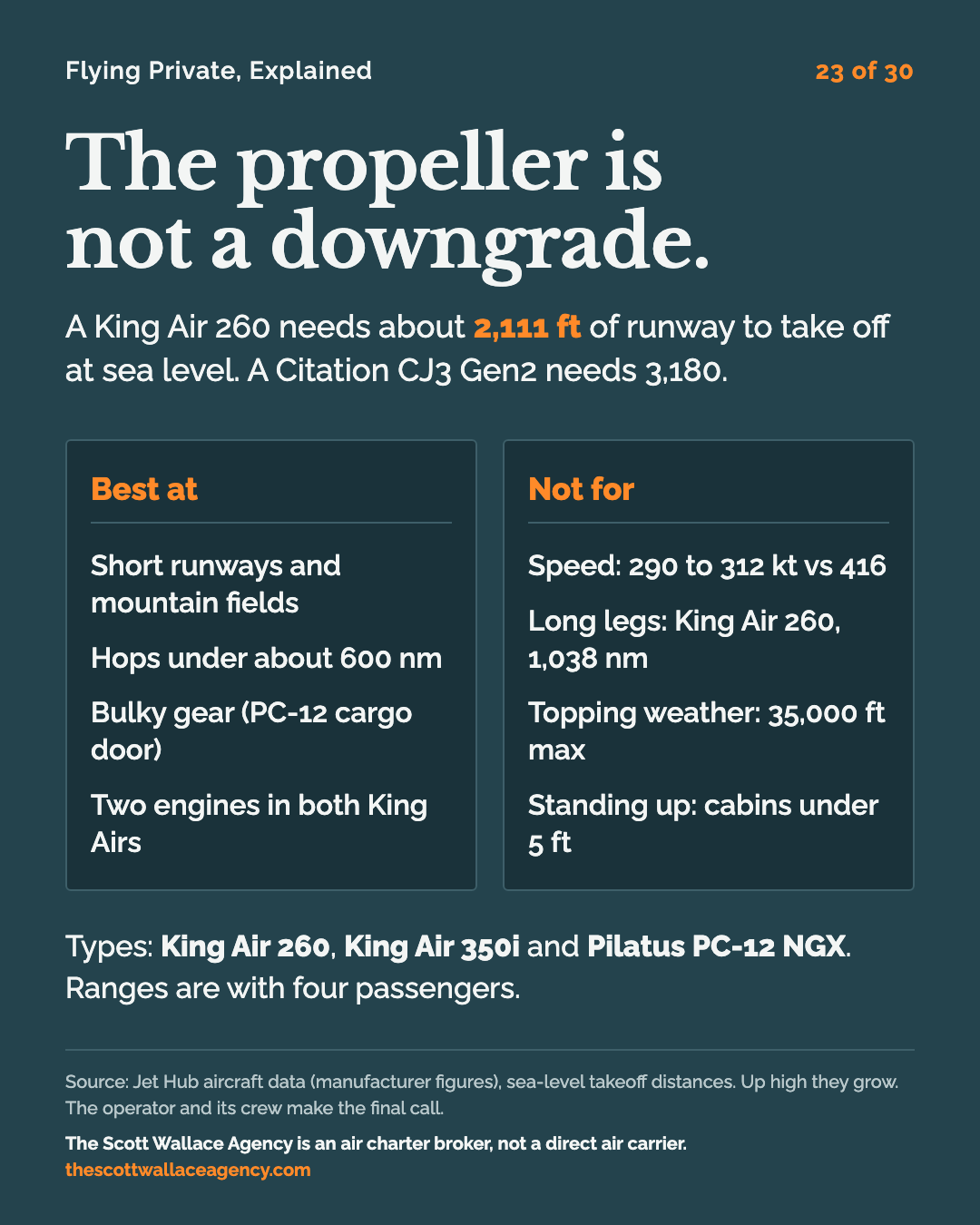
Turboprops get skipped by people who assume a propeller means old or slow. Slow, a little. Old, no. For the right trip they are the better aircraft, and the reason is runway.
At sea level, the King Air 260 needs about 2,111 feet to take off, the Pilatus PC-12 NGX about 2,600, and the King Air 350i about 3,300. A Citation CJ3 Gen2 light jet needs about 3,180. At a mountain field every one of those numbers grows, which is why my planning notes rate both King Airs strong for Aspen, Eagle County and Telluride.
What each one carries, with range quoted for four passengers:
- King Air 260: six seats, about 1,038 nm (the brochure's 1,720 is a ferry figure), 55.3 cu ft of baggage
- King Air 350i: eight seats, about 1,714 nm, 71.3 cu ft of baggage
- Pilatus PC-12 NGX: six seats, about 1,803 nm, one engine, and a 4 ft 5 in cargo door that takes skis and golf bags
Best at: short runways, mountain fields, hops of a few hundred miles, bulky gear, and cost. On our published cost page turboprops run an Est. $1,800 to $3,000 per flight hour, against Est. $7,400 to $8,600 for a light jet, before tax and before any daily minimum.
Not for: speed, long legs or climbing over weather. Cruise is 290 to 312 knots against about 416 for the CJ3 Gen2, and the ceilings are 30,000 to 35,000 feet where light jets reach 45,000. Past about 600 nm, a jet usually saves real time. Cabins are under five feet tall, so nobody stands up.
One more: the PC-12 has a single engine. Some company travel policies require two, which points to a King Air.
The operator and its crew run the performance numbers for your load and your day and make the final call on every flight.
Sources
Day 24of 30
Light jets and the Denver to New York test
Denver to New York is about 1,407 nm, which a Citation CJ3 Gen2 (1,660 nm with four passengers) covers on paper and a Citation M2 Gen2 (1,183 nm) does not, and light jets trade cabin height and bag space for that efficiency.

Centennial (KAPA) to Teterboro (KTEB) is about 1,407 nautical miles great-circle, worked out from the FAA's coordinates for both airports. Real routing and winds add to that. It is a good test because it sits right in the middle of what light jets can do.
Range here is quoted with four passengers:
- Citation M2 Gen2: about 1,183 nm. Short of New York nonstop. Strong for quick regional trips with two to four people.
- Citation CJ3 Gen2: about 1,660 nm. Makes it on paper with some margin. Takes off in about 3,180 feet at sea level.
- Phenom 300E: about 2,010 nm on paper. I treat this one as generous, because Embraer's published figure is for five people aboard counting the two pilots, which is three passengers in a typical two-pilot charter.
Best at: regional trips for two to six people, lower hourly cost than larger jets, and short or high runways. My planning notes rate the CJ3 Gen2 and the Phenom 300E strongest among light jets for Aspen and Telluride.
Not for:
- Standing up. Cabins run about 4 ft 9 in (M2 Gen2, CJ3 Gen2) to 4 ft 11 in (Phenom 300E).
- Lots of gear. Baggage is about 45.6 cu ft in the M2 Gen2, 65 in the CJ3 Gen2 and 74 in the Phenom 300E. Six people with ski bags can outgrow that.
- Full seats on a long leg. Every range above assumes four people. Fill the cabin and the nonstop distance comes down.
If a trip needs both the seats and the miles, that is usually the point where a midsize jet earns its higher rate. The operator and its crew run the numbers for your passengers, bags and day, and make the final call on every flight.
Sources
Day 25of 30
Midsize and super-midsize: what coast to coast depends on
Teterboro to Van Nuys is about 2,129 nm, which the Citation Latitude, Praetor 500 and Challenger 350 all clear with four passengers on paper; what they really buy you is a stand-up cabin, and the coast-to-coast promise depends on load and winds.
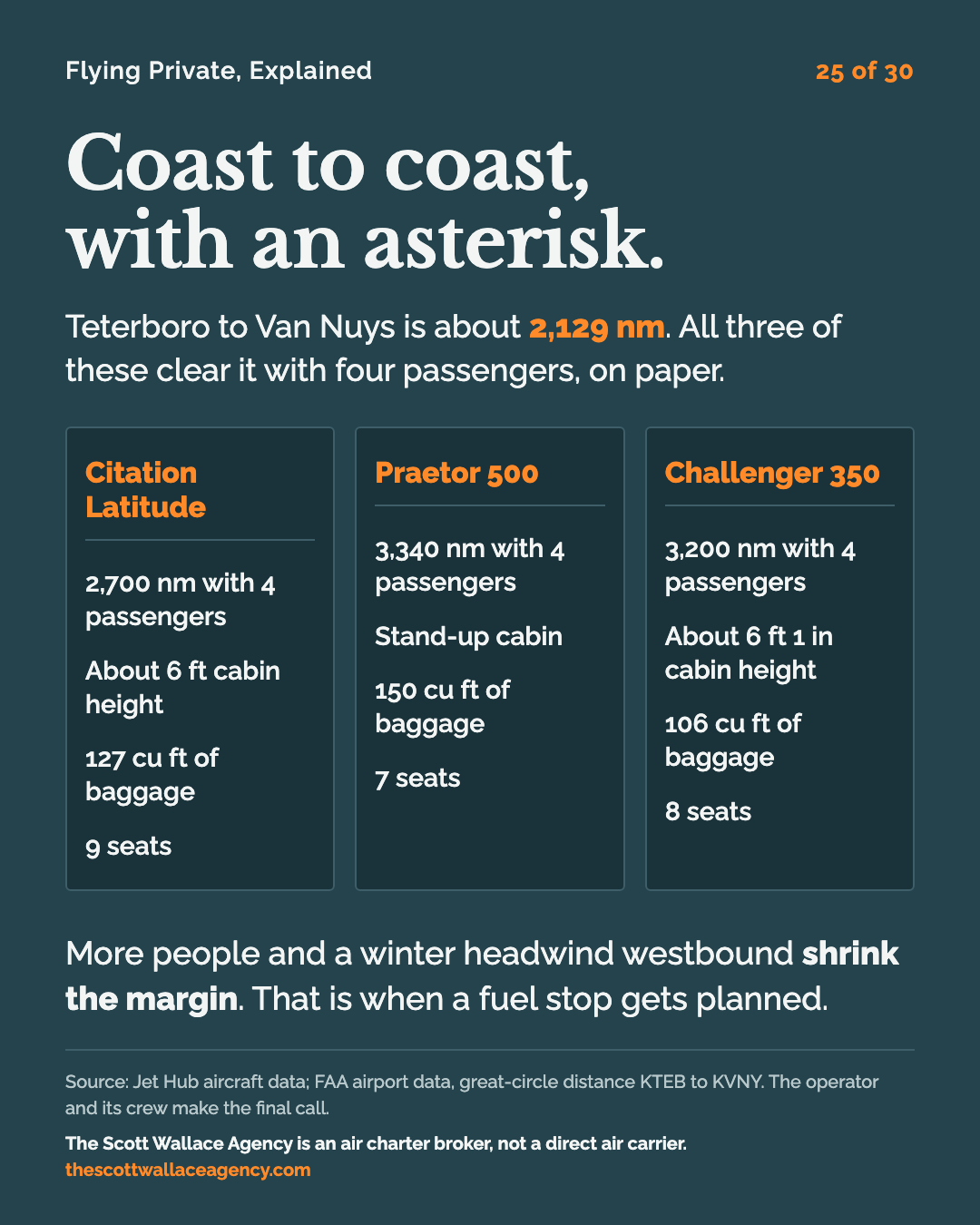
Teterboro (KTEB) to Van Nuys (KVNY) is about 2,129 nautical miles great-circle, worked out from the FAA's coordinates. With four passengers, the published ranges are:
- Citation Latitude (midsize): about 2,700 nm, nine seats, 127 cu ft of baggage, cabin about 6 ft tall
- Praetor 500 (midsize): about 3,340 nm, seven seats, 150 cu ft of baggage, stand-up cabin
- Challenger 350 (super-midsize): about 3,200 nm, eight seats, 106 cu ft of baggage, cabin about 6 ft 1 in tall and the widest of the three
So all three cross the country nonstop on paper. What 'coast to coast' really depends on is the load and the wind. Every range above assumes four people. Fill the seats and the distance drops. Fly west in winter into a strong headwind and it drops again. On those days an operator may plan a fuel stop, and the time to hear that is when you book.
The real step up from a light jet is the cabin. Light jets run under five feet tall; these let you stand, and the bags fit without a negotiation. For a three to five hour day, that is the difference people notice.
Not for: the short hop. On a 30-minute trip you pay a higher hourly rate for cabin you barely use. They also need more runway than a light jet: about 3,580 ft at sea level for the Latitude and 4,835 ft for the Challenger 350, before altitude.
The operator and its crew run the numbers for your passengers, bags and winds, and make the final call on every flight. Merry Christmas.
Day 26of 30
Heavy jets: when you need one, when you don't
Federal rules cap a two-pilot on-demand crew at 10 hours of flight time in 24, and longer legs need a third or fourth pilot with a sleeping place aboard, which is one real reason long trips go to a G550 or Global 6000, and why those jets are the wrong tool for short hops and tight runways.
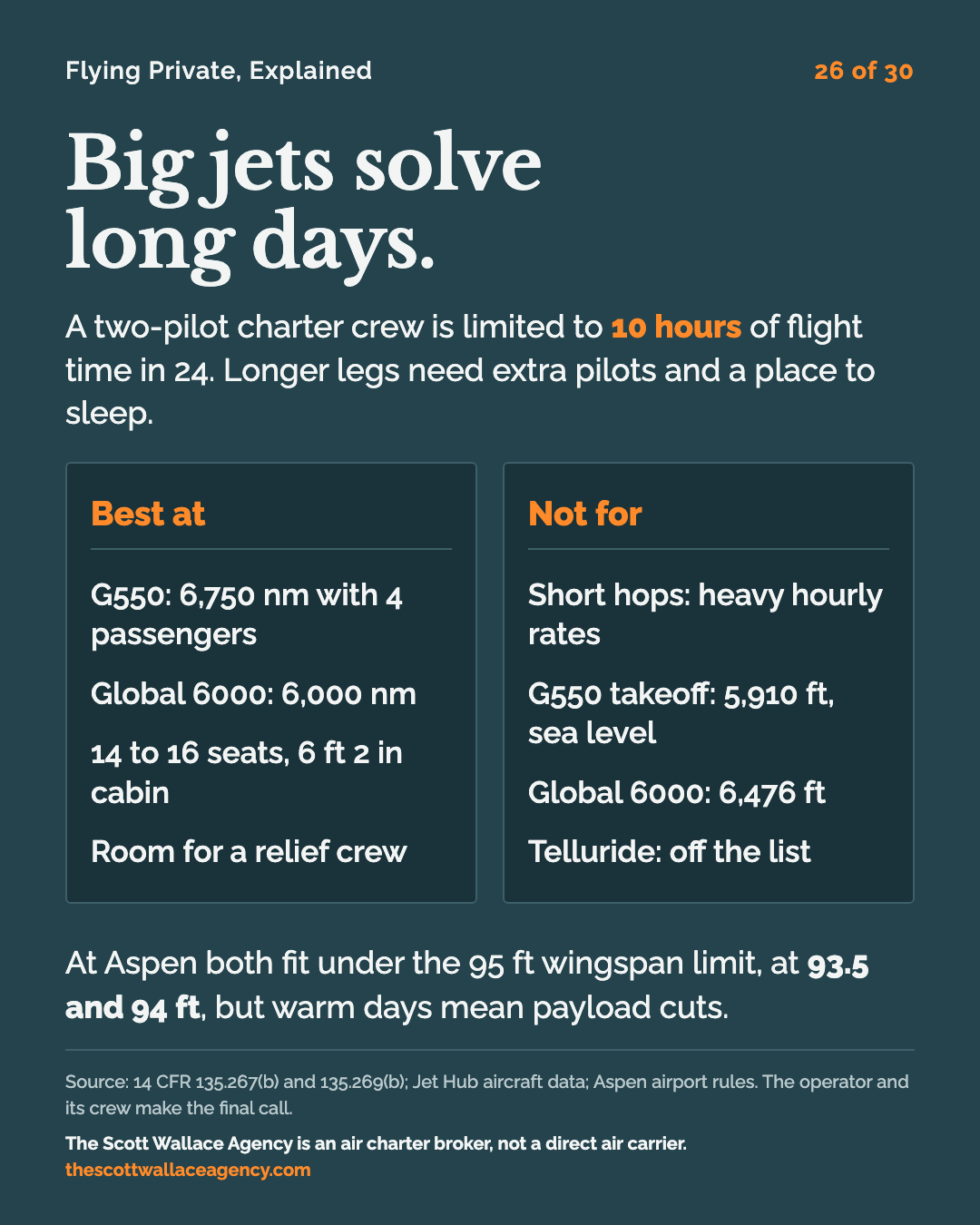
Under 14 CFR 135.267, a two-pilot crew flying on-demand charter may log no more than 10 hours of flight time in any 24 consecutive hours. Longer days need a three or four pilot crew under 135.269, which allows up to 12 hours aloft for three pilots and 16 for four, and requires adequate sleeping facilities on the aircraft for the relief pilot.
That is one practical reason long trips go to heavy jets. With four passengers:
- Gulfstream G550: about 6,750 nm, 16 seats in charter layouts, 170 cu ft of baggage, a cabin about 44 ft long and 6 ft 2 in tall
- Bombardier Global 6000: about 6,000 nm, 14 seats in charter layouts, 195 cu ft of baggage, a cabin about 43 ft long and 6 ft 2 in tall
Both ranges are the makers' eight-passenger figures, so with four aboard they understate a little.
Best at: long legs, ocean crossings, big groups, and days long enough that the crew needs relief.
Not for:
- Short hops. On our published cost page heavy jets run an Est. $12,800 to $19,200 per flight hour, against Est. $7,400 to $8,600 for a light jet, before tax and daily minimums. On a 90-minute trip you pay for range you never use.
- Tight runways. At sea level the G550 needs about 5,910 ft to take off and the Global 6000 about 6,476 ft. Teterboro's longest runway is 6,997 ft.
- Some mountain airports. At Aspen both fit under the 95 ft wingspan limit, at 93.5 and 94 ft, but at 7,838 ft of elevation warm days bring payload and fuel cuts, and Eagle County is often the better choice. Telluride is effectively off the list for this class.
The operator and its crew run the numbers for your trip and make the final call on every flight. My part is suggesting the big jet only when the mission calls for it.
Sources
- 14 CFR 135.267, flight time limitations, unscheduled one- and two-pilot crews (opens in a new tab)
- 14 CFR 135.269, flight time limitations, unscheduled three- and four-pilot crews (opens in a new tab)
- Aspen/Pitkin County Airport, aircraft limitations (opens in a new tab)
- Published charter cost ranges (opens in a new tab)
Day 27of 30
Five questions that pick the aircraft
Five questions (people, distance, bags, runway, and the day) narrow 80-plus charter aircraft types to two or three, and each one has a number behind it.
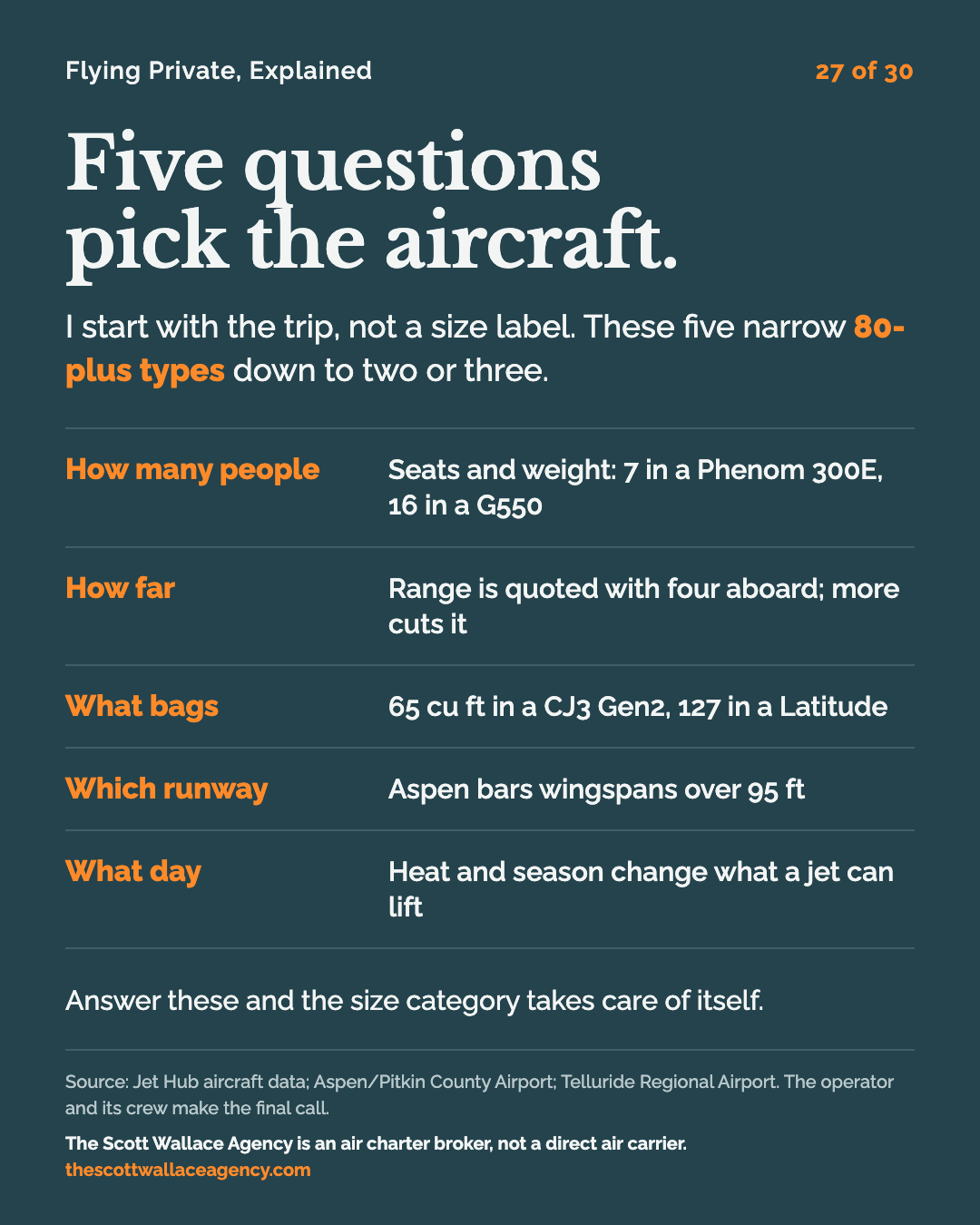
Clients often start with a size: 'a light jet should do it' or 'I want something big.' I start with the trip. Out of the 82 charter types in my aircraft notes, these five questions usually leave two or three.
1. How many people? This sets seats and weight. In typical charter layouts a Phenom 300E seats 7, a Citation Latitude 9, and a Gulfstream G550 16. 2. How far? Published range assumes four passengers. Denver to New York is about 1,407 nm, so a Citation M2 Gen2 at about 1,183 nm stops for fuel, while a Citation CJ3 Gen2 at about 1,660 makes it on paper. More people means less range. 3. What bags? A CJ3 Gen2 holds about 65 cu ft, a Latitude about 127. Skis and golf clubs push more trips into a bigger cabin than passenger count does. 4. Which runway? Some airports rule aircraft out by rule: Aspen bars wingspans over 95 ft. Others rule them out by physics: Telluride is at 9,070 ft with a 7,111 ft runway. 5. What day? Heat, snow and season change what an aircraft can carry out of a high field. Telluride's airport warns that density altitude can exceed 11,000 ft, and a trip that works in January can need a lighter load in July.
This lines up with our longer guide to choosing a jet, which adds two more worth asking: whether anyone needs to stand up (light jet cabins are under five feet tall), and whether the trip is for work or rest.
Answer the five and the category label takes care of itself. Then the operator and its crew run the performance numbers for your group, bags and day, and make the final call on every flight.
Sources
Day 28of 30
Your turn: match the trip to the aircraft
Readers match three real Colorado trips (96 nm, 1,407 nm and 2,910 nm) to a King Air 350i, a Citation Latitude and a Gulfstream G550, using distance, seats, bags and runway.
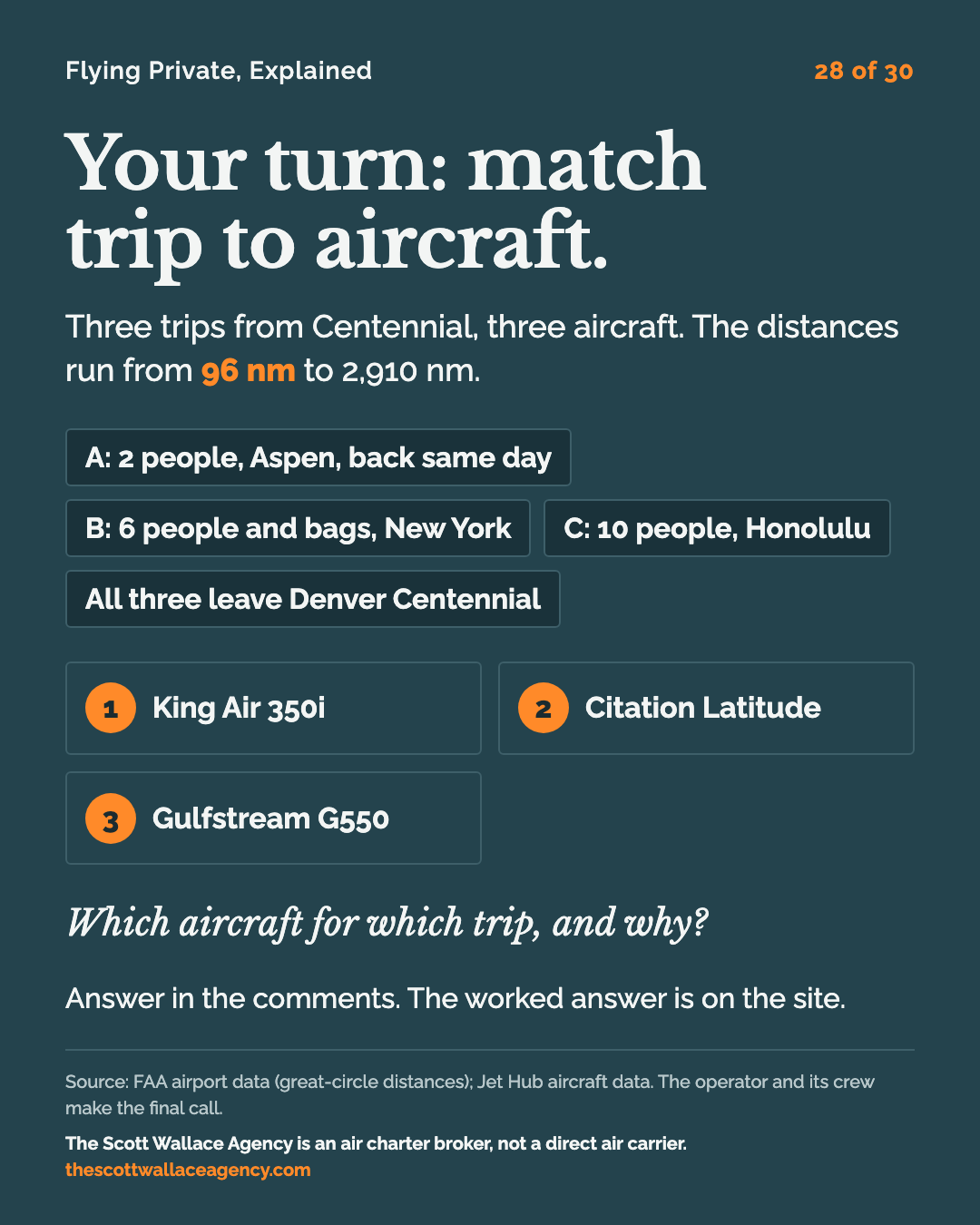
Distances are great-circle from Centennial (KAPA), worked out from FAA coordinates. Real routing and winds add miles. Ranges are quoted with four passengers.
A: Two people, Aspen and back the same day (about 96 nm). King Air 350i. Aspen's runway is 8,006 ft at 7,838 ft of elevation, and the 350i takes off in about 3,300 ft at sea level with two engines. My planning notes rate it strong for Colorado mountain fields. On a 96 nm leg a jet barely reaches cruise, so the turboprop gives up almost no time. A light jet such as a CJ3 Gen2 would also work; a G550 would be paying for 6,000 miles of range you never use.
B: Six people with bags, New York (about 1,407 nm). Citation Latitude. It is rated for about 2,700 nm with four passengers, so six people and their bags still leave margin. It has nine seats, 127 cu ft of baggage and a cabin about 6 ft tall for a three-plus hour day. The King Air 350i is the wrong fit here: about 1,714 nm with four leaves too little room once you add two more people and luggage, and it is roughly 130 knots slower.
C: Ten people, Honolulu (about 2,910 nm). Gulfstream G550. It seats 16 in charter layouts and Gulfstream rates it for about 6,750 nm, a figure published with eight passengers, so ten people still leaves wide margin over open water. The Latitude cannot do this one: at about 2,700 nm with four it falls short of Honolulu, and it seats nine.
The honest notes: every range shrinks as people and bags are added, headwinds can matter on the long legs, and summer at Aspen trims what any aircraft can carry. This is how I would frame the request to operators. The operator and its crew run the performance numbers for the actual load and the day, and they make the final call on every flight.
Sources
Day 29of 30
What a safety rating tells you, and what it does not
An ARGUS, Wyvern or IS-BAO rating is an audit of the operator as of a date, so the aircraft, the crew and the certificate for a specific trip still need their own check.
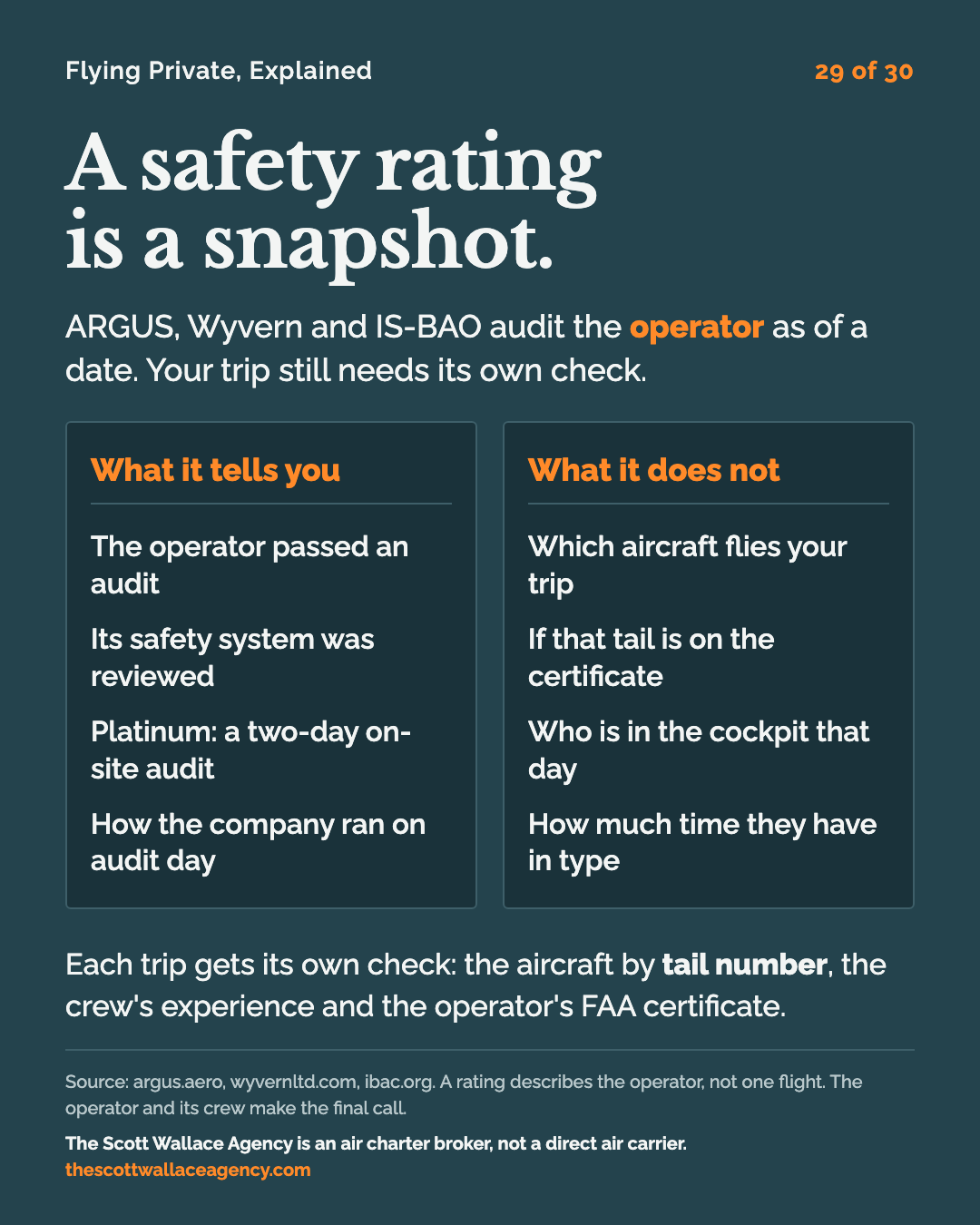
A safety rating is an independent audit of a charter operator. It is useful, and it has a limit worth knowing before you book.
Three programs come up in almost every safety conversation:
- ARGUS rates charter operators at four levels: Gold, Gold Certified, Platinum and Platinum Elite. Gold uses a remote audit. Gold Certified adds an on-site audit. Platinum is a two-day on-site audit. Platinum Elite is for operators with consecutive Platinum audits, and it adds maintenance and operations reviews every six months.
- Wyvern certifies operators to its Wingman standard, and there is also Wingman PRO. The evaluation covers the company's operations, its operational history and safety records, and its safety management system.
- IS-BAO is the business aviation standard run by the International Business Aviation Council (IBAC). Registered operators sit at Stage 1, 2 or 3. Stage 1 confirms the safety management system is in place, Stage 2 that safety risks are being managed, and Stage 3 that safety management is part of how the whole business runs.
Every one of these is an audit of the operator, as of a date. That is the part most people miss.
A rating cannot tell you which aircraft is assigned to your trip, whether that tail number is listed on the operator's FAA certificate, who is flying it, or how much time those pilots have in that type. Those details change from trip to trip, so they get checked for each trip: the specific aircraft by tail number, the crew's experience, and the operator's certificate.
ARGUS sells a trip-level report for this called TripCHEQ. ARGUS describes it as flight qualification software that verifies crew qualifications, aircraft qualification and a valid operating certificate. It covers one itinerary, so ask for it by name if you want one.
When you ask a broker about safety, ask for two answers. First, the operator's current rating, with the level or stage and when it was last audited. Second, what was checked for the aircraft and crew on your trip.
No rating, and no check, takes the place of the people flying the trip. The operator and its crew make the final call on every flight.
Sources
- ARGUS Gold Certified (describes the Gold and Gold Certified levels) (opens in a new tab)
- ARGUS Platinum audit (opens in a new tab)
- ARGUS Platinum Elite (opens in a new tab)
- ARGUS CHEQ and TripCHEQ (opens in a new tab)
- Wyvern Wingman certified operator, scope of evaluation (opens in a new tab)
- IBAC, IS-BAO and its three stages (opens in a new tab)
Day 30of 30
What a broker does, and why Stratos Jets
The company you pay for a charter usually is not the one that flies you, and a broker must name the operator before you sign, which explains what a broker is for: finding the aircraft, checking it, handling the back office and being the one person you call.
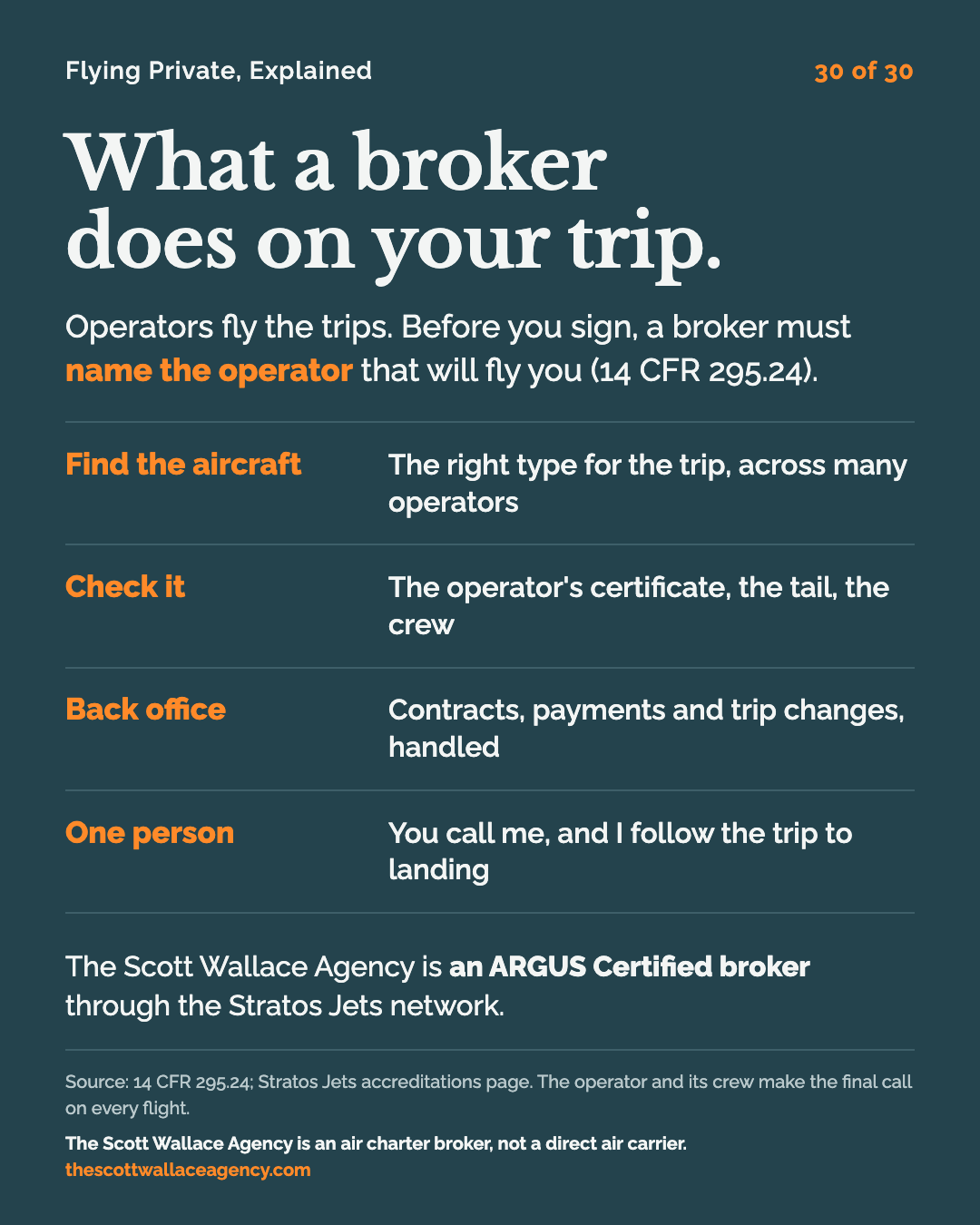
The company you pay for a charter is usually not the company that flies you. A federal rule makes that plain. Under 14 CFR 295.24, before you sign, a broker must give you the corporate name of the air carrier in operational control of your flight and say in what capacity the broker is acting.
The operator holds the FAA certificate, employs the crew and flies the trip. The broker works on everything around the flight. Here is what that means on a trip with me:
- Finding the aircraft. I match the aircraft type to the trip, the passengers and the airports, from operators across the country, and tell you why I picked it.
- Checking it. Before the trip is confirmed, I look at the operator's certificate, the specific aircraft by tail number, and the crew's experience.
- The back office. The team behind me at Stratos Jets handles the contracts, the payments and the changes when plans move.
- One person. You call me, I answer, and I follow the trip from the first call to landing.
The Scott Wallace Agency is a Stratos Jets franchise and an ARGUS Certified broker through the Stratos Jets network. Stratos Jets also runs FlightGuard, a program that helps pay the added cost of a recovery aircraft after a covered mechanical problem.
This is the last day of Flying Private, Explained. The 29 days above cover how charter is priced, how range and runways shape which aircraft can do a trip, how the airports work, and how to judge an operator. If you have a trip in mind, I am glad to talk it through.
The operator and its crew make the final call on every flight.