
Beechcraft King Air 350i
Turboprop - 8 passengers, 1,806 nm published range
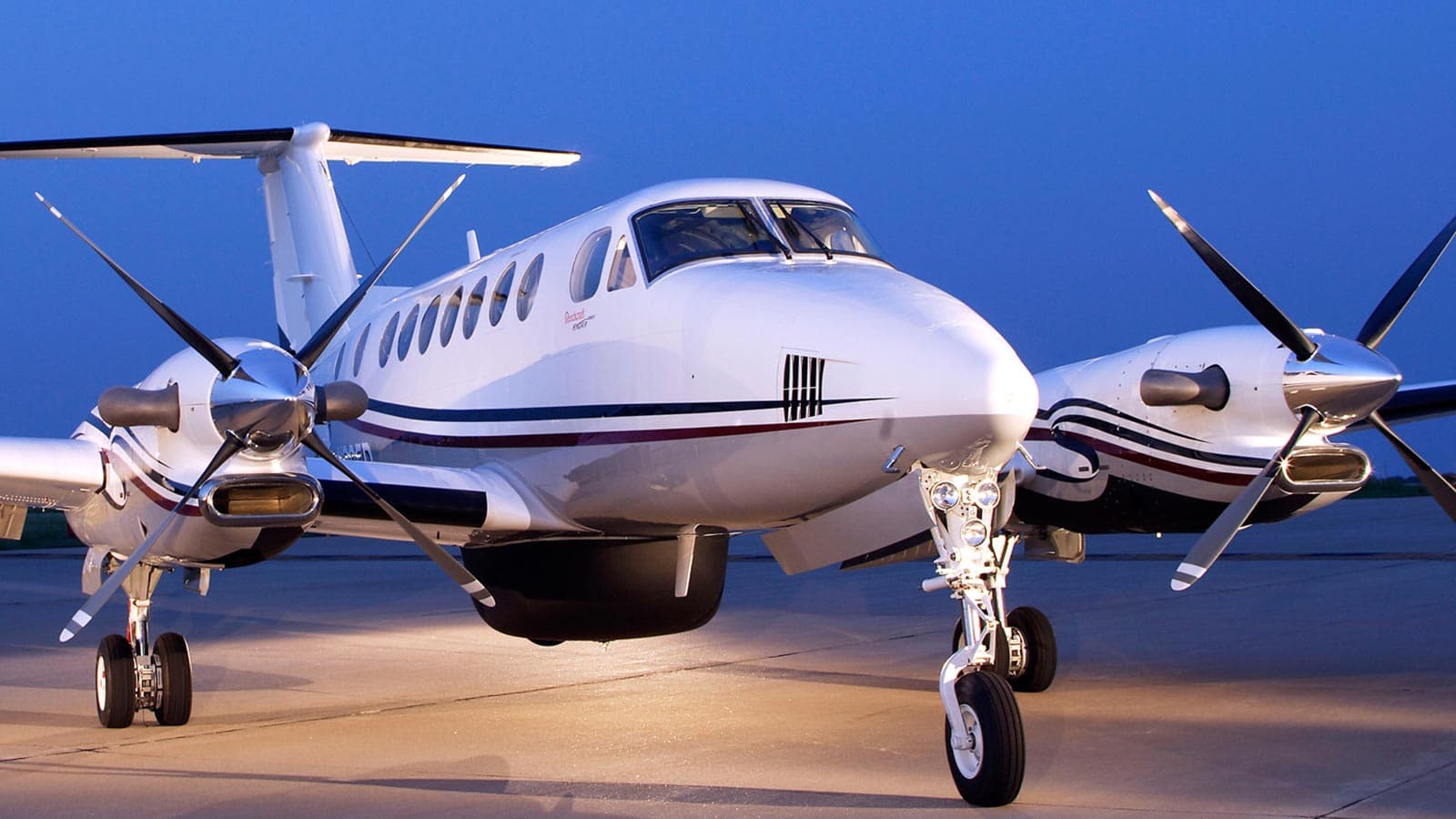
About the Beechcraft King Air 350i
The Beechcraft King Air 350i is the stretched, winglet-equipped member of the King Air family and the most widely chartered twin turboprop in North America. It carries up to nine passengers in a 19 ft 6 in cabin with a private aft lavatory, cruises at 312 ktas and covers about 1,714 nm with four passengers aboard, and works comfortably off short, unpaved and high-elevation runways that a light jet cannot use.
Who charters it
Strong for mountain and short-field missions where the runway, not the clock, sets the constraint. A 3,300 ft takeoff field length, two PT6A-60A engines and a genuine nine-seat cabin with a private aft lavatory make it a practical choice into Aspen, Telluride, Jackson Hole and unpaved strips, and it holds payload on a hot, high day better than most light jets. It is not the right aircraft when speed or range is the point. At 312 ktas and about 1,714 nm with four aboard, a transcontinental trip means a fuel stop and several more hours than a light jet, the cabin sits higher than a jet cabin at altitude, and passengers used to a Citation will notice the propeller noise. Hourly rates for this aircraft are estimate ranges for planning, not quotes.
Mission fit: the Beechcraft King Air 350i at a glance
A sturdy turboprop for a good-sized group on regional trips from shorter fields, though headroom is limited and the pace is slower than a jet.
Best for
- Short regional legs, where a turboprop's slower cruise costs little time
- Teams of up to 8 in typical seating
- Shorter runways, with a published takeoff distance of about 3,300 ft
Think twice if
- Legs much past 600 nm, where a jet saves real time
- Standing room matters: the cabin is about 4'9" tall
Mountain airports
Strong. A regular choice into Aspen, Eagle and Telluride when the day's weight and weather allow.
Computed from specifications current as of 2026-09-28. Range lines start from the 1,714 nm four-passenger figure, hold back a reserve and fly into a 50 kt headwind. Winds, weight and the operator's own performance numbers decide any given day. Check your route in the Range Explorer.
Specifications
- Class
- Turboprop
- Manufacturer
- Textron Aviation (Beechcraft)
- Published range
- 1,806 nm
- Range with four passengers
- 1,714 nm
- Planning range (85% reserve, 50 kt headwind)
- 1,223 nm
- Seats
- 8 typical, 9 max
- Service ceiling
- 35,000 ft
- Takeoff field
- 3,300 ft
- Cabin height
- 4'9"
- Cabin width
- 4'6"
- Cabin length
- 19'6"
- Indicative rate
- Est. $2,250 - $3,500/hr
- Production
- Out of production
Specifications current as of 2026-09-28. Published range assumes still air, an optimum profile, and a light payload. Rates are indicative and vary with routing, availability, and operator.
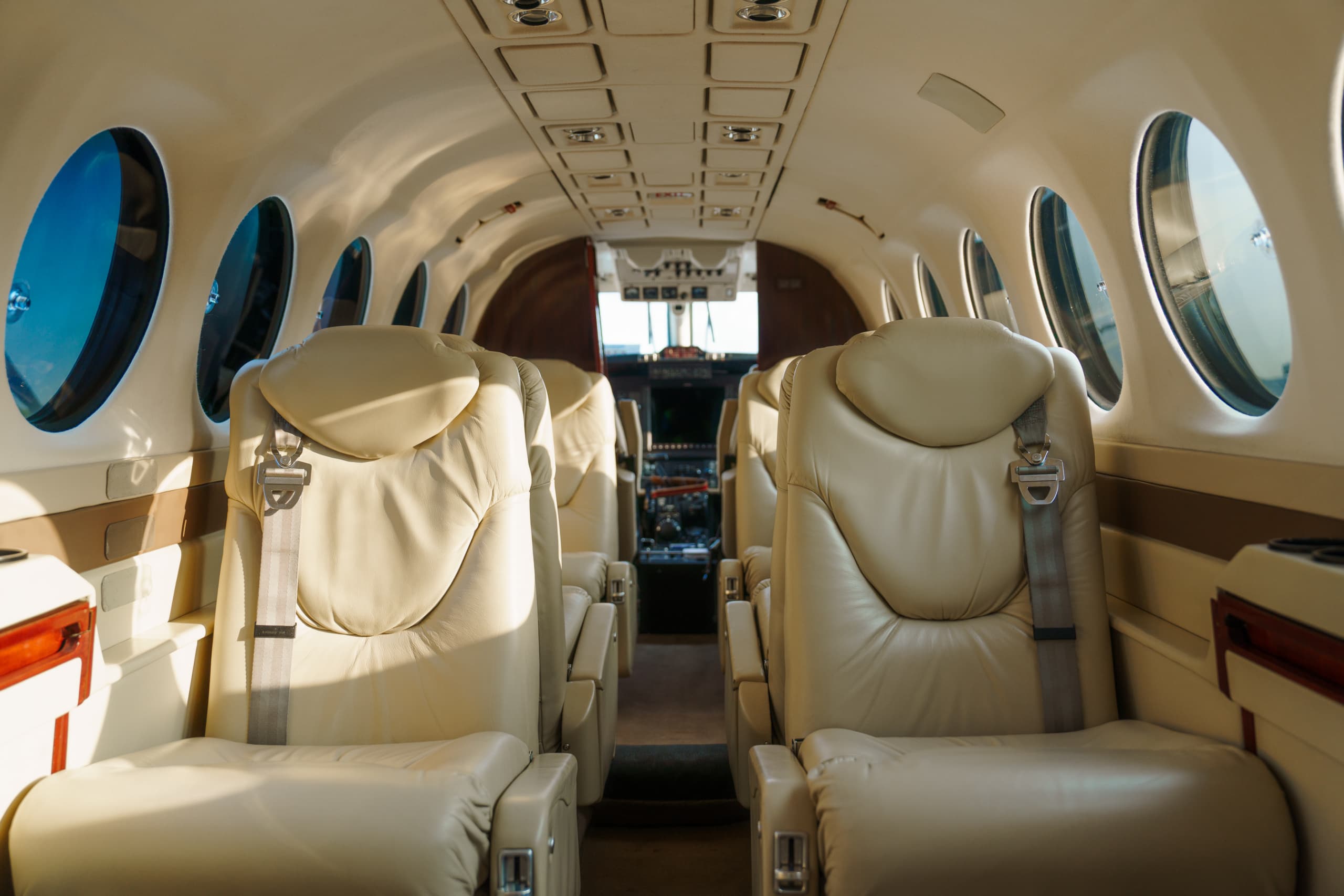
Worth knowing
- Two Pratt & Whitney Canada PT6A-60A engines rated at 1,050 shp each
- 3,300 ft takeoff field length with unpaved and high-elevation runway capability
- 19 ft 6 in cabin with a private aft lavatory, the longest in the King Air line
- 71.3 cu ft of baggage volume and a 1,150 lb baggage allowance
- Collins Aerospace Pro Line Fusion touchscreen flight deck
Colorado mountain airports: strong
Twin PT6A-60A power and a 3,300 ft sea-level takeoff distance make this one of the strongest turboprop choices for Colorado mountain airports; one charter-industry source names it the gold standard turboprop for landing at Telluride (TEX). ASE and EGE are routine with normal load planning. TEX is less about runway length than sustained climb-out through terrain reaching 11,000 to 14,000 ft, and summer density altitude on the mesa erodes climb margins and can force payload cuts, so treat full-passenger, full-fuel TEX loads as conditional on cool conditions rather than a given. Real single-engine climb performance is the advantage this twin holds over the single-engine turboprops in this dataset.
Planning guidance only. The operator, the AFM performance data, and conditions on the day are the final authority.
FAA Part 135 data
On US charter certificates
107
aircraft on FAA Part 135 charter certificates
51
certificate holders operate them
Counted: King Air 300 and 350 series, including the 350i (FAA models 300, B300 and B300C)
Built 1984 to 2026
Being on a certificate means an aircraft may be flown for hire. It does not mean every one is offered to the public. For each trip we confirm the specific operator and aircraft, and review its safety audits, before you book.
- Pilatus PC-12 NGX243
- Beechcraft King Air 200 / B200198
- Beechcraft King Air 350i107
- Beechcraft King Air 26022
Source: FAA Part 135 Operators and Aircraft list, as published September 10, 2026.
Is the Beechcraft King Air 350i right for your trip?
See how far it reaches from your departure airport, or send us the trip and we will price it against the alternatives.